

Communist party of India history: The Communist Party of India traces its origins to the Kanpur meeting held on December 26, 1925. Here is the story of its formation
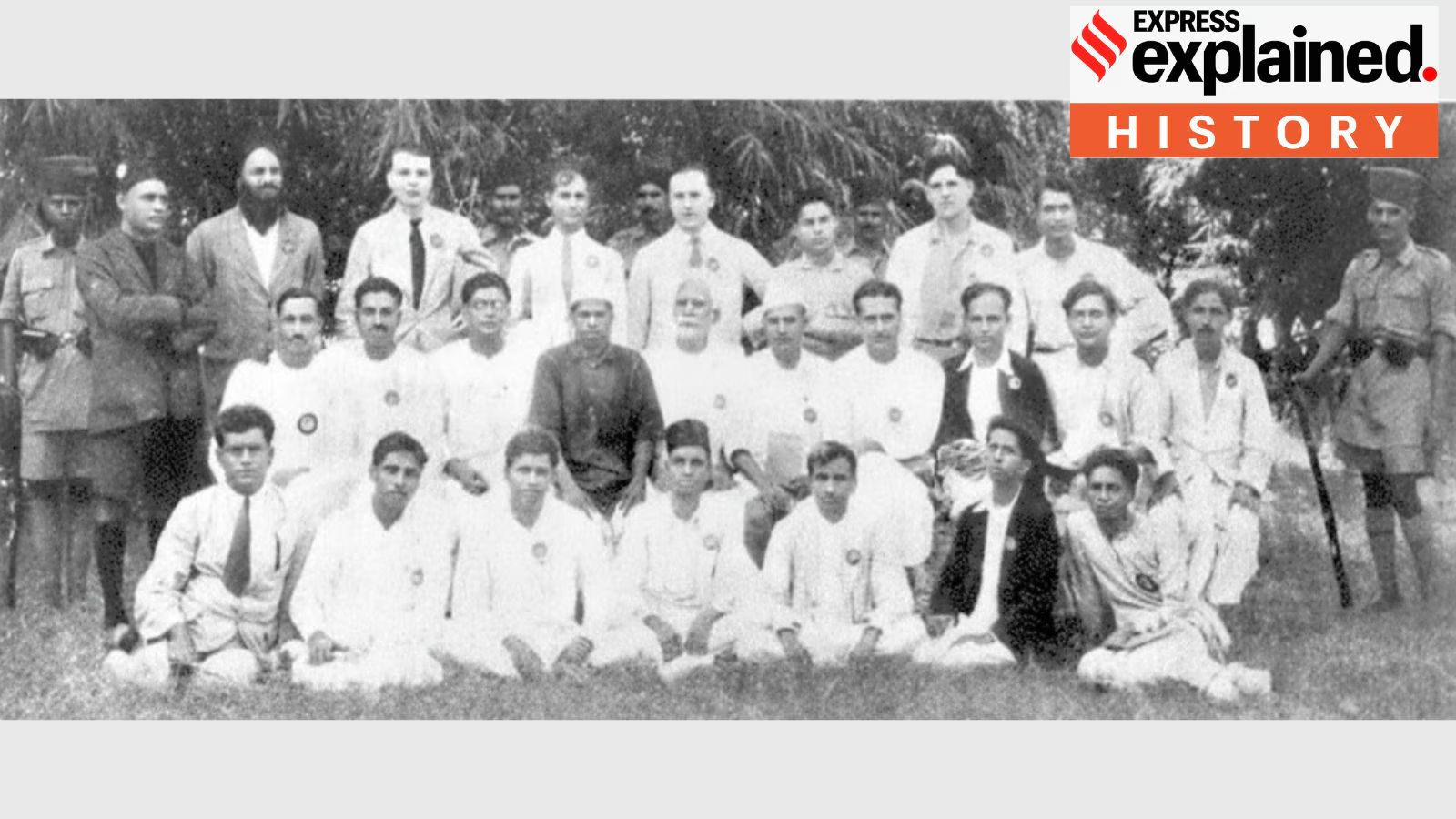
The Communist leaders jailed for Meerut Conspiracy. Back row (left to right): K. N. Sehgal, S. S. Josh, H. L. Hutchinson, Shaukat Usmani, B. F. Bradley, A. Prasad, P. Spratt, G. Adhikari; Middle Row: R. R. Mitra, Gopen Chakravarti, Kishori Lal Ghosh, L. B. Radam, D. R. Thengdi, Goura Shanker, S. Bannerjee, R. N. Joglekar, P. C. Joshi, Muzaffar Ahmad; Front Row: M. G. Desai, D. Goswami, R. S. Nimbkar, S. S. Mirajkar, S. A. Dange, S. V. Ghate, Gopal Basak. (Wikimedia Commons)
Written by Salil Misra
New Delhi | Updated: December 27, 2025 01:25 PM IST
100 Years of CPI: The Communist Party of India (CPI) considers December 26, 1925 as its foundation date. On that date, Communist groups from the country met in Cawnpore (now Kanpur)in what is recognised as the first concerted effort on Indian soil toward forming an all-India Communist party. A century later, Salil Misra, Visiting Faculty at the BML Munjal University, in a conversation with Arjun Sengupta, looks back at the events that led up to the meeting, and the story of how the Communist movement took root in India.
Global antecedents: French Revolution, Marx, Lenin
Following the French Revolution (1789) and the Napoleonic wars (1796-1815), all of Europe was politically divided between monarchists, defenders of the old order, and republicans, supporters of change in a modern direction. This was the beginning of what later came to be identified as the Right-Left binary.
Economically, whereas industrialism generated affluence, it also created an inegalitarian society with increased disparities. In this political-economic landscape of Europe, Karl Marx, a German philosopher settled in England, prepared a manifesto for Communist parties, which would carry along the transformation of the entire human society from capitalism to socialism. He anticipated that the capitalist system, with its headquarters in Europe, was bound to collapse under the weight of its own inner contradictions. This would be followed by a just and superior socialist system.
Obviously, Marx expected this transformation to first occur in Western Europe, the citadel of capitalism. On the contrary, the first successful socialist revolution occurred in 1917 in the Russian empire, which was economically backward by European standards and ruled by an autocratic regime of the Tsars.
The Russian revolution, also known as the Bolshevik and Socialist revolution, was against medieval monarchism, modern capitalism, and its offshoot, imperialism. As such it was bound to have a great appeal in the non-European countries suffering under imperialist domination. Soviets and Communist parties sprang up all over in the non-European countries. The Communist movement in India was deeply inspired by the Russian revolution and Vladimir Lenin, its main leader.
Three political strands in India
There were broadly speaking three political strands which fed directly into the formation of the Communist Party of India.
First was represented by M N Roy, a Marxist revolutionary, who had spent some years in the US, Mexico, Berlin and later the USSR during the course of the First World War. He was trying to generate resources — money and weapons — for India’s liberation.
Roy became the Indian representative at a meeting of the Soviet-led Communist International (Comintern) of 1920, which discussed prevailing conditions in colonial countries. The Comintern instructed the Communists in these countries to first focus on the struggle against imperialism, for which they were to get into a temporary alliance with all the anti-imperialist forces. The Comintern also resolved to set up a meeting of Asian representatives at Tashkent, then in Soviet Turkistan.
There were other groups of diasporic Indian revolutionaries active in Berlin, led by Virendranath Chattopadhyay, and Kabul, led by Raja Mahendra Pratap.
Second, and quite independent of these diasporic initiatives, were independent Left groups which sprang up in parts of India: in Lahore, led by Ghulam Hussain, in Bombay (now Mumbai), led by S A Dange, in Calcutta (now Kolkata), led by Muzaffar Ahmad, and in Madras, led by Singaravelu M Chettiar. They were waiting for an opportunity to develop coordination with one another for more effective political work.
Third, organizations of workers and peasants had also come up by the 1920s. An All-India Trade Union Congress (AITUC) was formed in 1920, under the presidentship of Lala Lajpat Rai.
All these three strands eventually flowed, in one way or the other, into the Communist movement in India.
Tashkent & Kanpur: tale of two meetings
As mentioned earlier, the Comintern had decided to hold a meeting of the Asian representatives in Tashkent. Two Indian revolutionaries — Abdul Rab and Trimul Acharya — were already active in Central Asia. They, along with Raja Mahendra Pratap and M N Roy, decided to set up a Communist party in Tashkent in 1920 and got the approval of the Comintern.
The émigré Communist party of India resolved to liberate India from British imperialism and set up conditions for socialism. However, the Tashkent party did not have the support of other Indian revolutionary groups active in Europe. Nor did it have any connection with the revolutionary groups active in India.
In the meantime, Indian Communist groups, active in Lahore, Bombay, Calcutta and Madras, decided to meet and organise a national conference in 1925 in Kanpur, an industrial town in present-day Uttar Pradesh with a substantial presence of industrial workers. The annual session of the Indian National Congress was also being held in Kanpur at the same time.
Moreover, it was also in Kanpur that the British government had instituted the Kanpur (Cawnpore) Bolshevik Conspiracy case against Indian Communists in 1923, and charged them with conspiracy against the British empire. Three Communist leaders — S V Ghate, S A Dange and Muzaffar Ahmad — were sentenced for four years.
The Kanpur conference resolved to set up the Communist Party of India and declared the creation of a workers and peasants republic as the main aim of the party. It also listed the liberation of India from British domination and the socialisation of means of production and distribution, as its major objectives.
So, was the Communist party formed in Tashkent in 1920 or in Kanpur in 1925? The two major factions that developed after the split of 1964 — the CPI and the CPI (Marxist) — hold very different opinions on this. (The 1964 split was a culmination of long-standing differences within the party about relations with the national bourgeoisie that was represented by the Congress, the limits of working within the Indian constitution, and the Sino-Soviet Split, among other things.)
The CPI (M) considers the Tashkent meeting in 1920, with its clear international location and approval by the Comintern, as the historic starting point. The Kanpur conference in 1925 was purely an Indian initiative, with little connection from outside, and much more allied to the anti-imperialist struggle developing in India.
For the CPI, it was Kanpur in 1925 and not Tashkent in 1920 that constituted the foundation moment of the Communist party. Moreover, the Tashkent venture was associated with M N Roy, who used to be considered a renegade, and had been expelled from the party. In the discourses on Indian Communism, Kanpur signifies the Indian part of Communism, whereas Tashkent exemplifies its Communist component.
Communists in India’s anti-Imperial struggle
The Communists remained actively involved in the anti-imperialist struggle throughout, except the conjuncture of 1942-45 when, during the Second World War, they treated the global struggle against Fascism as more important than the national struggle against British imperialism.
During 1925-28, the Communists were active in the formation of workers and peasant parties (WPPs). But they were caught in the unresolved question of how to deal with the Congress; whether they should try to transform it from within in a socialist direction, or create a separate front that would be an alternative to it. Politics of transformation versus that of alternative remained a central dilemma and plagued the Communist movement during the entire course of the anti-imperialist struggle.
In 1929, the Communist leaders were accused of organising a railway strike and charged under the Meerut Conspiracy Case. The party was banned and many of its leaders sentenced to long imprisonment and deportation. In the 1930s the Communists formed a United Front with the Congress Socialist party (CSP), formed in 1934 within Congress, and other anti-imperialist forces. The United Front experiment, however, broke down in 1939.
During the period after 1945, the Communists led crucial peasant struggles, the Tebhaga movement in Bengal, demanding a greater share of the agricultural produce for cultivators, and the Telangana struggle in the princely state of Hyderabad, for a redistribution of land to cultivators. They also supported the spontaneous struggles of the common people against British imperialism.
After Independence, the energies of the Communist movement were bifurcated, with one strand going into an underground, violent insurrectionary direction, and the mainstream of the Communist movement opting for a parliamentary democratic route to capture state power. Through the electoral route, they formed governments in Kerala, West Bengal and Tripura, and also occasionally shared power with other mainstream parties at the Centre.
Both the Communist doctrine and specific Communist practices have been subjected to criticism and denigration. Charges of authoritarianism, corruption and obsolescence have often been levelled against them. However, it remains an undisputed fact that with all the technological advances, the modern world still remains sharply divided by a social equator, with its beneficiaries located above the equator and victims below. With all its limitations and contradictions — and there are many — Communism as a principle stands with those below the social equator. It started as a great philosophic intervention in favour of the dis-privileged, and still remains relevant for that reason.
Salil Misra is Visiting Faculty at the BML Munjal University, Manesar
Sourced from indianexpress.com


