

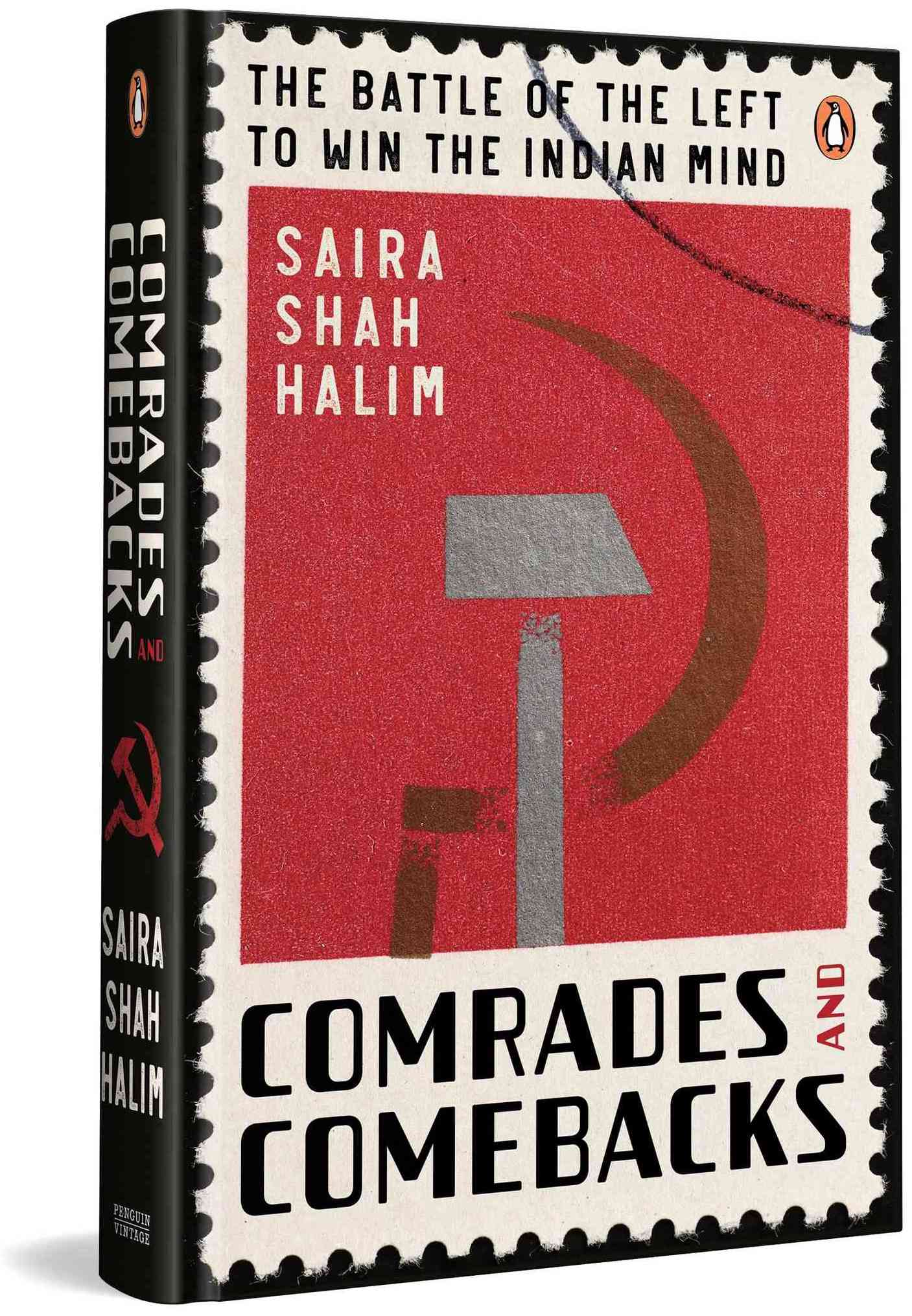
An excerpt from ‘Comrades and Comebacks: The Battle of the Left to Win the Indian Mind’.
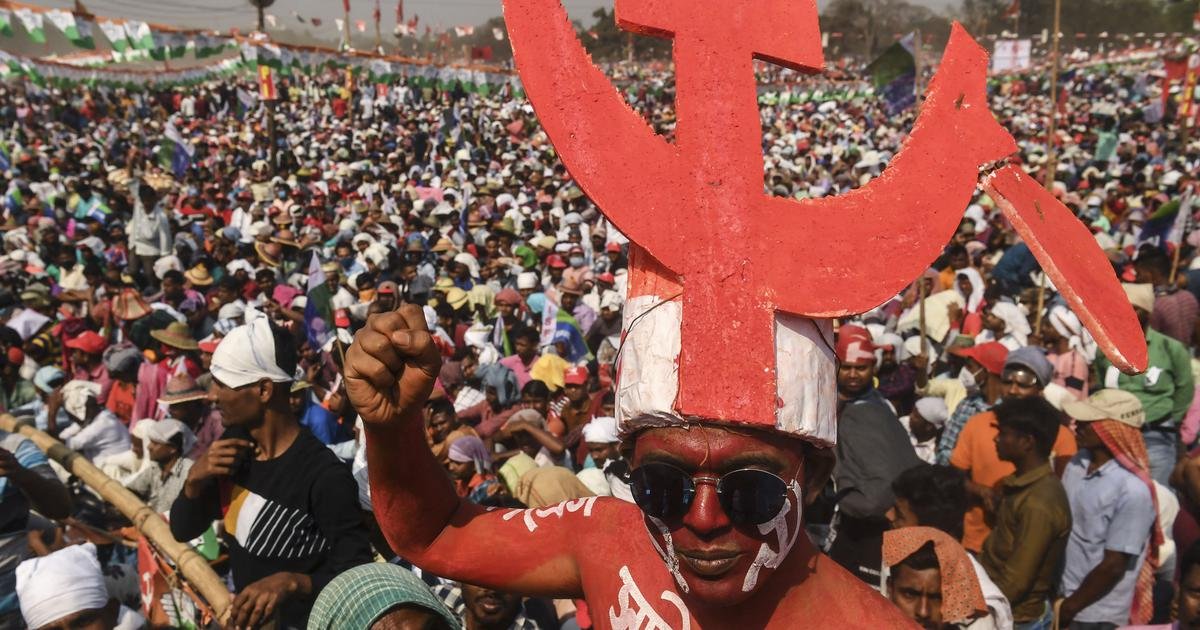
Can you believe it, around 20 years ago, the communist parties of India were regarded as the third-largest alliance of the country and they had a vote-share that got them 59 out of the 543 seats in the Lok Sabha?
Sadly, in the 2019 election, the Left parties hit an all-time low by winning only five seats. However, in the 2024 general elections, the Left parties won nine seats across the country, including the CPI(M) winning two seats in Tamil Nadu, one in Kerala and one in Rajasthan; the CPI winning two seats in Tamil Nadu; and the CPI(ML) winning two seats in Bihar.
Additionally, the United Democratic Front (UDF) candidate, NK Premachandran, who is a veteran Revolutionary Socialist Party (RSP) leader, won the Kollam Lok Sabha seat, marking his third victory in a row. It can safely be said that, though enmeshed in an existential struggle, the communist parties perked up their performance marginally in the last Lok Sabha election.
After the results, CPI(M) leader Sitaram Yechury tweeted:
The image of invincibility built around Narendra Modi and his boast of winning more than 400 seats is busted. The credible showing of the INDIA bloc countered Modi’s communal electioneering and championed issues of the defence of the Constitution, democracy and people’s livelihood issues. The verdict signals that our people are determined to fight back all attacks on the Constitution, democracy & livelihoods.
India has long been a sociopolitical oddity, a country with widespread poverty and wretched deprivation, mostly where the underprivileged find no voice in most political parties; one of the world’s fastest-growing economies where less than a tenth of the population has regular jobs and where a quarter of a million farmers have committed suicide in the past few decades; a democracy with largely free and fair elections, yet which failed to establish the rule of law and where human rights violations are rampant in the form of caste, religion and gender-driven hatred and discrimination.
A pertinent question that comes to mind is why left-wing politics has not flourished in India to the extent that might be expected in a society with a million injustices and growing inequalities, recently worsened by Hindutva and neoliberal capitalism. In fact, it has shrunk in range and variety.
The Indian Left was once a rainbow comprising breathtakingly different currents, including parliamentary and non-parliamentary communist parties; socialists of different hues ranging from the Congress socialist party to the Gandhians, to followers of the viscerally anti-Congress Ram Manohar Lohia.
It included anti-caste movements with radical agendas associated with Ambedkar’s Republican Party of India or later with the Dalit Panthers and Maoists and Marxist-Leninist parties, which believed in an insurrectionary seizure of power.
Earlier, there used to be independent groups such as the peasants and workers party (PWP) and Lal Nishan Party in Maharashtra or the Revolutionary Communist Party of India in West Bengal and Assam, which set regional agendas; there were currents like the Chhattisgarh Mukti Morcha (CMM) of Shankar Guha Niyogi that aimed to create embryos of workers and peasants republics; and there were many smaller progressive currents that aimed to rescue revolutionary Marxist politics from its distortions. Since then, the rainbow has contracted in size and lost some of its hues.
The socialists have long ceased to have a coherent organisational expression, barring the largely caste and community-based, family-driven Samajwadi Party, but groupings like Samajwadi Samagam have grown. The once-strong PWP is now a feeble force. The CMM has split irrevocably.
Liberal social democracy, which found expression in the Congress and other centrist parties, has anyway been weak in India. Since then, new differentiations have appeared within the Left spectrum, the most important of which is the division between the party left and non-party political left.
The latter comprises people’s movements, structures and federations of civil society groups, such as the National Alliance of People’s Movements, National Fisherman’s Forum, Alliance of People’s Movements, National Fishworkers Forum, All India Union of Forest Working People, Mazdoor Kisan Shakti Sangathan, Indian Social Action Forum, New Trade Union Initiative, Shramik Mukti Dal, New Socialist Initiative, Radical Socialist and Campaign for Survival and Dignity.
Quite a mouthful, huh?
In the Indian political repertoire, the 1980s are known as a time of disruptive changes. It was during this decade that the BJP was fast making its presence felt as a dominant pan-Indian alternative to the Congress. The political environment underwent sea changes during this decade and the Indian Left retreated to a more defensive position during the 1980s and 1990s, and was to an extent enfeebled by the rise of the Hindutva narrative.
There was also a rise in many regional parties, whose political agendas were pegged around the concept of “identity politics”, a nebulous but highly influential idea involving mobilising voters around regional, caste, gender, language or religious identities. Moreover, the regional parties were concerned with local and regional socio-economic concerns rather than national ones.
This shift in the political dynamics soon made it difficult to rule the states and the country sans the support of these regional parties.
Interestingly, some of the regional party leaders were rooted in Left ideology and found their inspiration from the Left-leaning political thinkers. For example, the Anti-Brahmin movement and the Dravidian parties in Tamil Nadu – the DMK (founded in 1949) and the AIADMK (founded in 1972), were deeply inspired by Erode Venkatappa Ramasamy (Periyar), a social activist and politician who started the Self-Respect Movement and Dravidar Kazhagam and is the ‘Father of the Dravidian movement’.
Similarly, the Bahujan Samaj Party (BSP), founded in 1984 in Uttar Pradesh, was influenced by Bhim Rao Ambedkar, the principal architect of the Indian Constitution and a champion of Dalit and women’s rights. Additionally, the parties that emerged in Karnataka, Odisha, Bihar and Uttar Pradesh, as a result of the splits in the Janata Dal (Popular Front) – namely Janata Dal (United), Biju Janata Dal, Rashtriya Janata Dal and the Samajwadi Party – considered Ram Manohar Lohia, the intellectual leader of Indian socialism, as their idol.
The exponential rise of neoliberalism and the financialisation of the economy in the 1990s also put the Left on the back foot.
Society was experiencing a new socio-economic context. In the subsequent years, the urban middle classes were enticed by the spunky promises of liberalisation, which included economic growth, individual opportunity and consumerism. This often led them to renounce their earlier solidarity with the Left, who were dead against neoliberalism, considering it the reason behind the widening economic and income inequalities amongst the rich and poor, and the decline of the purchasing power among the majority of the people.
In their pursuit of the new aspirations generated by liberalisation of the economy, the affluent urban middle class with more disposable income further drifted from the traditional Left, who remained focused on labour rights, social equality and state-led development. Hence, the communists struggled to connect with the changing priorities of the emerging urban electorate.
But let’s go back in time.
Soon after Independence, the business and industry sectors denounced the workers’ demands, which led to an increase in strikes. Consequently, the Industrial Truce Conference was convened to facilitate dialogue between the government, industry leaders and the working class to address the issues and create avenues for dialogue.
However, one of the aftermaths of this conference was the demobilisation of trade unions. The trade union leaders were increasingly egged on to relinquish their confrontational tactics and participate in co-management of organisations.
The next blow came with the introduction of new legislative measures, particularly the Industrial Disputes Act (1947). This further eroded the labour movement. According to the new Act, at least fourteen days’ notice and mandated arbitration processes, which usually take months or even years to resolve, became mandatory for holding strikes and lock-outs. This change encouraged state paternalism. According to many communist leaders, despite claiming to be a socialist, Nehru’s government preferred capital over labour.
Also, establishing robust workers’ bodies in India was a difficult task for the Left as the Indian economy comprised largely of a massive informal employment sector and a much smaller organised industrial sector. It was only in the states of Kerala, West Bengal and Tripura, where communist parties have held power for extended periods, that structured labour organisations could be built. But the eventual structural weakness of the trade unions in these states also contributed to the decline of the Left in India and the communists of today are finding it difficult to voice their social demands emphatically.
SOURCED FROM SCROLL.IN
@freemang2001gmail-com


