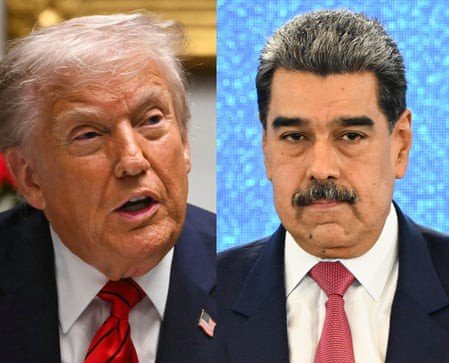
America had no fundamental problem with Venezuela or its former elite. The real problem for the US government and its corporate class was with the political process initiated by Hugo Chavez's first government.In 2001, Savage's Bolivarian Process passed the "Organic Hydrocarbons Law." This law ensured state ownership of all oil and gas reserves.Processes such as oil field exploration and extraction are left in the hands of state-owned companies, but the refining and sales process is open to participation by private—even foreign—companies.Despite possessing the world's largest petroleum reserves, Venezuela had already nationalized oil in 1943 and 1975.
But in the 1990s, the oil industry was again widely privatized as part of neoliberal reforms imposed by the IMF and major US oil companies.When Savage implemented the new law, the state regained control of the oil industry. About 80 percent of the country's foreign income came from oil sales abroad.
US-owned oil companies, particularly ExxonMobil and Chevron, were furious and pressured the administration of US President George W. Bush to take action against Savage.In 2002, the United States attempted a coup to overthrow Savage, which failed within days.

Then they started a strike against the corrupt Venezuelan oil company management, which aimed to destroy the economy. In the end, it was the workers who saved the company and took it back from management.Savage survived both the coup and the strike because he had overwhelming public support behind him.Maria Corina Machado, who received the Nobel Peace Prize in 2025, founded an organization called “Sumate” (meaning “Add”), which organized a withdrawal referendum.

In 2004, about 70 percent of registered voters turned out to vote, and a large majority (59 percent) voted to keep Savage as president.Yet neither Machado nor his American backers—which included oil companies—relented.Since 2001, they have been trying to overthrow the Bolivarian process, mainly to bring US-owned oil companies back to power.So the question in Venezuela is not about “democracy” (a word that is so overused that its meaning is eroding);Rather, it is a question of international class struggle—the right of the Venezuelan people to control their oil and gas versus the dominance of US oil companies.
The Bolivarian Process
When Hugo Chavez entered the political arena in the 1990s, he stirred the imagination of the Venezuelan people, especially the working class and peasants.This decade was marked by the betrayal of presidents who came to power promising to save the oil-rich country from IMF-imposed austerity and implemented precisely those policies.Whether they were social democrats (such as Carlos Andrés Pérez, 1989–1993) or conservatives (such as Rafael Caldera, 1994–1999)—hypocrisy and betrayal defined politics in all cases.At the same time, there was terrible inequality. Savage's electoral victory (56 percent of the vote, against 39 percent for the candidates of the old parties) was a referendum against this hypocrisy and betrayal.

From 1999 to 2013, Savage and the Bolivarian Process benefited from relatively high oil prices. Savage established control over oil revenues and used them for social development.He launched several mass-based social programs—including primary health care, literacy and secondary education for workers and farmers, food security, and housing.The state is reorganized as a vehicle for social justice, not as a tool to deprive workers and peasants of the benefits of the market. Alongside these reforms, the government creates participatory structures—such as communes—to build popular power.Communes develop local development plans, control public funds, establish cooperative banks, and social production institutions.This was one of the most ambitious initiatives of the Bolivarian process, an attempt to establish popular power as an alternative to the rule of the rich and powerful.
The US-imposed hybrid war on Venezuela
Two events in 2013–14 deeply threatened the Bolivarian process. First, the premature death of Hugo Savage (only 58 years old); second, the collapse of oil revenues.Savage's successor, Nicolas Maduro, faced a collapse in oil prices in June 2014, when prices were around $108 per barrel, falling below $50 in 2015 and below $30 in January 2016.This was disastrous for Venezuela, which relies on oil exports. Even before Savage's death, the United States and its allies had developed a framework for a hybrid war against Venezuela.
Hybrid warfare refers to the combined use of economic pressure, financial strangulation, information warfare, legal manipulation, diplomatic isolation, and selective violence, with the aim of subverting the sovereign political project.Hybrid warfare is conducted by weaponizing every aspect of daily life.Attacks on currencies, sanctions, creating product shortages, media narratives, pressure from NGOs, harassment using the judicial system, and artificially creating a legitimacy crisis.The goal of all this is to destroy the capacity of the state, exhaust popular support, and break the unity within society.
The resulting suffering is then presented as an 'internal failure' to hide the external coercive structure.Venezuela has been facing this exact situation ever since the United States illegally imposed financial sanctions on Venezuela in August 2017 and tightened them further in 2018.These sanctions severely disrupted all financial transaction systems and commercial channels in Venezuela and forced the country to comply with additional US regulations.At the same time, Western media systematically downplays the impact of sanctions, portraying inflation, product shortages, and the migration crisis as purely internal problems, further reinforcing the narrative of regime change.The catastrophic decline in living standards in Venezuela between 2014 and 2017 cannot be separated from this stratified strategy of economic strangulation.Mercenary attacks, sabotage of the power grid, creating conflict between Guyana and Venezuela for the sake of ExxonMobil.
Maria Corina Machado has promised, if the country returns to the state it was in in 1998, all the democratic progress achieved through the 1999 constitution will be nullified.In fact, Machado even said that the US bombing of the Venezuelan people would be an “act of love.” The slogan of those who want to overthrow the government is “backwards.”
” Meanwhile, in October 2025, President Nicolas Maduro said in English at a rally in Caracas, “Listen to me - I want peace, not war, this is my message to the people of the United States.” "This is not a change of government, which reminds us of endless and failed wars like Afghanistan, Iraq, Libya. This is not a CIA-led coup," he said in a radio address that night.“I want peace, not war”—the line quickly spread on social media and was even turned into a song. Maduro has sung it to the beat of music at rallies and debates on multiple occasions, and has even appeared wearing a hat with the message on it at least once.
 Courtesy: People's Dispatch
@freemang2001gmail-com
Pankaj Dhar Choudhury
Pankaj Dhar Choudhury, B.A Hons. in English, M.A in English, B.ED.
He passed Madhyamik from his native village Kumar Gram Duar of Alipurduar district. He got B.A Hons. in English from Alipurduar College. He completed M.A in English from North Bengal University, Siliguri. He completed B.ED from Maldah Govt. Teachers" Training College. He has been a social media activist since 2006.
Ethan Caldwell shares thoughtful insights and reflections on life, culture, and personal growth. His work explores the intersections of creativity and experience, offering readers unique perspectives.