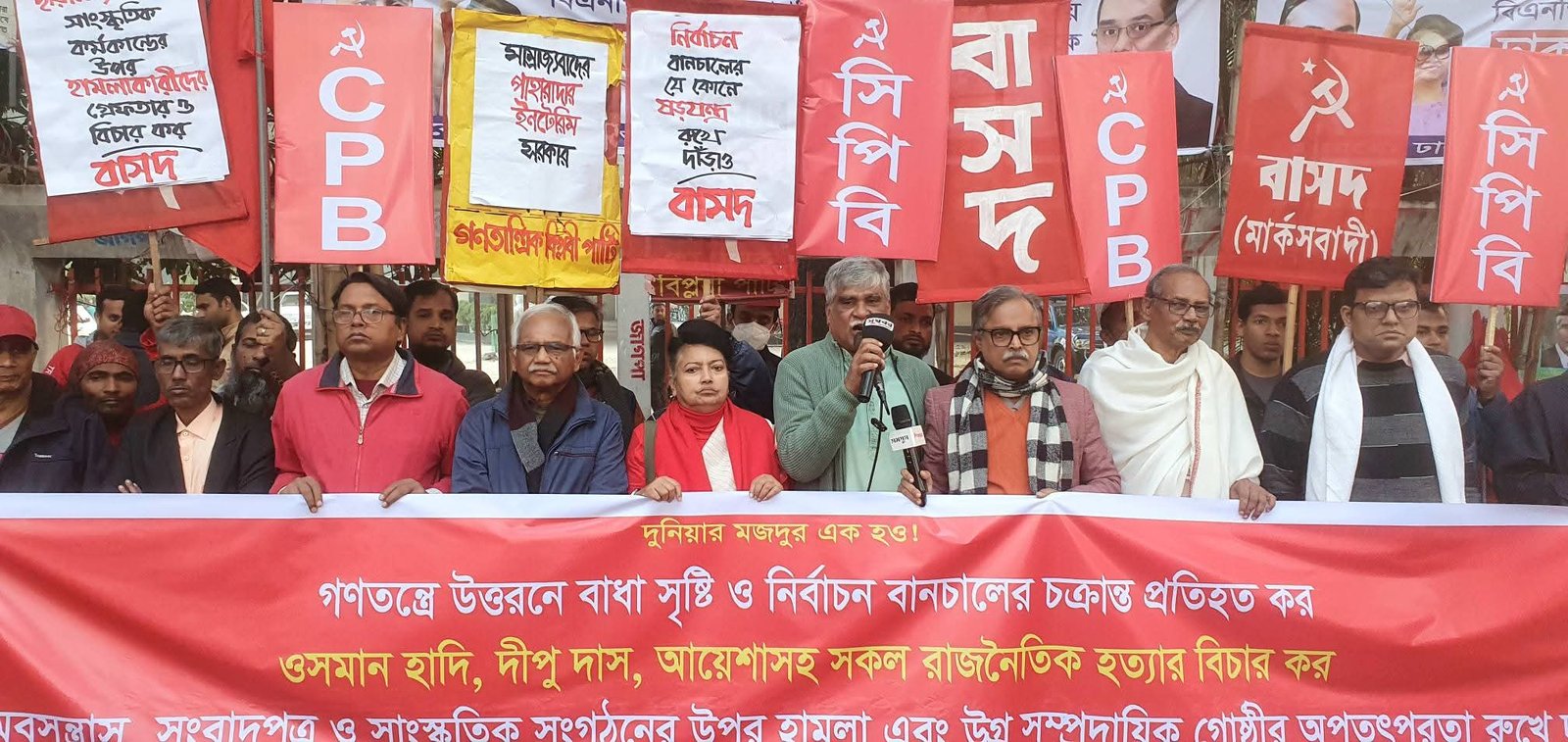
In the election campaign that began on January 22, 2026, candidates from the larger alliance of left-wing parties, the Democratic United Front, have continued to campaign to the best of their ability, against the huge money and manpower of the major parties. Their campaign battle was naturally uneven. However, the Democratic United Front did not reach an agreement on any seats. In many seats, the front's partner parties have multiple candidates. None of the front's partners could field candidates in all 300 parliamentary seats. The CPB has fielded the highest number of candidates. They have 63 candidates contesting the election under the sickle symbol. In addition, the CPB has fielded 17 candidates from religious minorities. This is the highest among all the political parties participating in the election. No other party has fielded so many minority candidates.
The election manifestos of the left-wing parties mainly focus on farmers, workers, and the working class. In addition, leftist parties have made various commitments, including democratic reconstruction, elimination of economic inequality, establishment of the rule of law, ensuring freedom of the media and expression, and ensuring women's rights. Leaders and activists of leftist parties have been touring villages with manifestos. They have gone door to door, talked about the people's needs, listened to their grievances and demands, and expressed their hope to work on them if elected.

Abdullah Al Kafi Ratan, general secretary of the Communist Party of Bangladesh (CPB), one of the allies of the united front, said, "The major parties did not follow the election rules. They spent a lot of money. In the constituency I am contesting (Comilla-5), hundreds of billboards of candidates from major parties have been put up. However, there is no rule in the election code of conduct that allows for more than 20 billboards. We conducted the election campaign in accordance with the code of conduct.'' Regarding the campaign experience, Kafi Ratan said, "The campaign was good. People responded. We did the campaign work according to our organizational capacity. We are optimistic that the Democratic United Front and the CPB will do well in the elections.'' Among the left-wing candidates in this election, the most talked about is Bangladesh Samajwadi Party (BSD) candidate Manisha Chakraborty. She is contesting from Barisal-5 (Sadar) constituency. Manisha has been working among the workers of her constituency for a long time and has been very vocal about the suffering of the local people. The discussion includes Communist Party of Bangladesh (CPB) President Kazi Sajjad Zahir Chandan. He is contesting from Narsingdi-4 (Belabo-Manohardi) constituency, which was once a stronghold of the left. Mehedi Hasan Ratul, who is in charge of managing Sajjad Zahir Chandan's election activities, said, "This area has a history of fierce resistance from leftists during the Liberation War." Even after independence, the Communist Party remained strong here for many years. "While campaigning, we have met one or more former Communist Party leaders and activists in every house here, who have been away from active politics for many years, but are still supporters of the party. We are hopeful." On the last day of the election campaign, a public meeting was held in support of CPB candidate for Netrokona-4 constituency Jolly Talukder at the Mohanganj Shaheed Minar premises in Netrokona. A procession was also held with the candidate. The banner and placards feature a picture of the party's symbol, the sickle, and the words, "I will decorate the country of equality with compassion, if we win, the night of the sickle will end."

The left-wing parties have lagged behind the BNP and Jamaat in their election campaigns on social media and at the field level. The main reason for this is 'economic', another is the relatively small manpower. There is also the neglect of the mainstream media. Left-wing parties are financing their election expenses on donations from party leaders and supporters, which is considerably less than what is needed. On the other hand, behind the big parties, the hands of the country's big businessmen are invisible. Naturally, there was a huge difference in their election campaign procession and strength with the leftists. However, leaders and activists of these parties have worked tirelessly, surpassing everything else. In many areas, they have competed with the big parties in campaigning.

It is worth noting that the Bangladesh Workers' Party, one of the leftist parties outside the alliance, is not participating in this election. Rashed Khan Menon, the former president of the party, which was in government with the Awami League, is currently in prison. Although the activities of the Workers' Party are not banned like the Awami League, they are under attack. Cases are also being filed. The office has also been attacked several times. Left activists are relentless in their unequal struggle.

@freemang2001gmail-com
Pankaj Dhar Choudhury
Pankaj Dhar Choudhury, B.A Hons. in English, M.A in English, B.ED.
He passed Madhyamik from his native village Kumar Gram Duar of Alipurduar district. He got B.A Hons. in English from Alipurduar College. He completed M.A in English from North Bengal University, Siliguri. He completed B.ED from Maldah Govt. Teachers" Training College. He has been a social media activist since 2006.
Ethan Caldwell shares thoughtful insights and reflections on life, culture, and personal growth. His work explores the intersections of creativity and experience, offering readers unique perspectives.