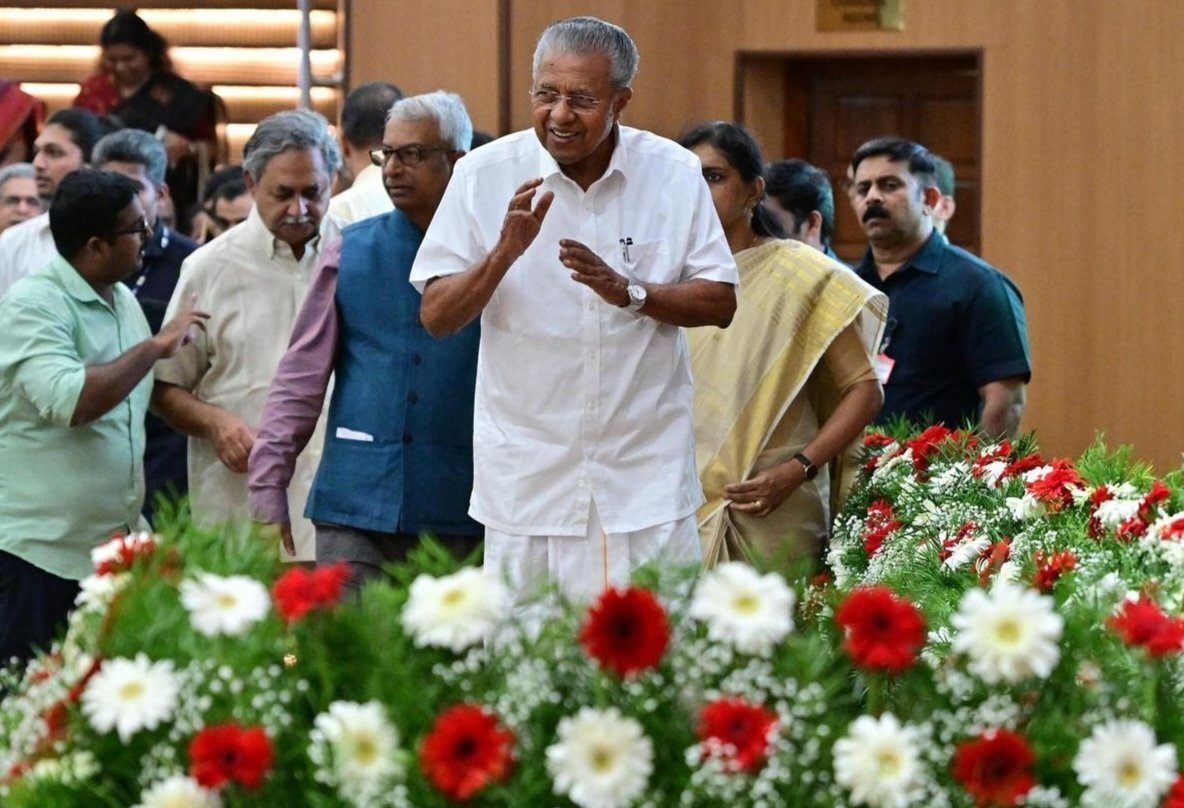
Former Jammu and Kashmir Chief Minister Farooq Abdullah strongly criticized the Central government's policies, focusing on three issues: national unity, federal structure and democratic rights. He spoke at the 'Vision-2031' international conference organized by the Kerala State Planning Board on Tuesday. Today was the last day of the conference. The state's Chief Minister Pinarayi Vijayan also spoke at the closing session. It is worth noting that in this seminar, economist Amartya Sen had called Kerala a current model for the country through virtual means. Eminent historian Romila Thapar praised the development and progress of Kerala in various fields, including education. Prakash Karat, eminent journalist N. Ram and others were present at the closing session. The gist of what the speakers said at today's meeting is that India's strength lies in unity in diversity, and if that foundation is weak, democracy will also be at risk.

Referring to Kerala's secular spirit, Chief Minister Pinarayi Vijayan said at the event that secularism here is not just a constitutional principle but a practice of daily life in schools, neighborhoods and workplaces. He claims that while polarization is increasing in India, like in many societies around the world, Kerala has maintained social harmony through inclusive public institutions and a culture of mutual respect. Quoting Nobel laureate economist Amartya Sen, Vijayan said that social cohesion is a prerequisite for development. Without trust within the community and faith in institutions, economic activity, innovation and investment are not possible. He said that Kerala's secular spirit is one of the state's most valuable economic assets.

Describing the decision to abrogate Article 370 and downgrade Jammu and Kashmir to a Union Territory as a "tragedy" for the people of Kashmir, he said that despite these steps, terrorism has not been eradicated; rather, the fundamental rights of people, freedom of movement, speech and expression have come under question. Recalling the definition of democracy, he said that this ideal of "of the people, for the people, by the people" is weak in Kashmir today. He accused Kashmiri students of being labeled as 'Pakistani' in various educational institutions in North India, saying that this is increasing their mental and social pressure. Responding to the Centre's demands on the issue of terrorism, he raised the issue of Pulwama, Pahalgam and Udhampur attacks and asked, "If the attacks do not stop even after the abrogation of Article 370, then where is the real result of the promise?" Highlighting the deterioration of Centre-state relations, he said, "Over-centralisation is against the federal structure of India. If all decisions are taken by Delhi, then where is the autonomy of the states?" Farooq Abdullah asked.

Kashmir's economy is largely dependent on horticulture and tourism, and he fears that international trade agreements, especially the recent trade deal with the United States, could put apple, walnut and almond farmers in uncertainty. Indicating foreign pressure on energy policy as well, Abdullah said that international pressure is increasing on the questions of which country India will buy oil from or at what price it will sell the product.

Vijayan said that in a context where various states in the country are facing increasing financial constraints, while the responsibility for public services and development is increasing, Pinarayi Vijayan emphasized the need for predictability and fairness in the Centre-State financial relationship. Speaking at the closing session of the 'Vision 2031' international conference, he said that today, states are playing an important role in delivering public services and advancing development. But their financial space is gradually shrinking.

Referring to the experience of Kerala, the Chief Minister said that the state has consistently maintained a high ratio of own revenue collection and has maintained a strong public service structure. However, changes in the intergovernmental financial arrangements, borrowing limits and central grant structures have created new challenges. He said this question should be viewed in the context of democratic governance, not in terms of conflict. A cooperative federal structure requires predictability, fairness, and respect for constitutional roles. States must have sufficient financial capacity to fulfill their responsibilities in areas such as health, education, social security, and infrastructure. Vijayan said that despite financial constraints, Kerala continues to prioritize welfare programs, education and public services. He also noted that the measures taken for students, workers and the weaker sections of society are an attempt to strike a balance between fiscal responsibility and social commitment. The Chief Minister said, 'Vision 2031' is not just a policy document; it is a collective effort of introspection, dialogue and imagination - a blueprint for understanding the past, evaluating the present and building the future on the eve of the state's 75th anniversary.

He also mentioned that public policy formulation in Kerala has always been a participatory process through dialogue between the state and society. Kerala's development journey has been built on a series of land reforms, investments in public education and health, social protection, and decentralized planning—this experience proves that the market alone cannot ensure social justice, he commented. He also said that economic growth should be judged on its ability to ensure dignity and basic security for all. Vijayan said that the discussion on ‘Vision 2031’ has made it clear that Kerala’s future strategy is based on three interrelated principles – growth with quality employment, democratic participation and social justice. Vijayan stressed that the Kerala of 2031 will be prosperous, innovative and tolerant. But above all, it must remain steadfast in its democratic and secular spirit.

@freemang2001gmail-com
Pankaj Dhar Choudhury
Pankaj Dhar Choudhury, B.A Hons. in English, M.A in English, B.ED.
He passed Madhyamik from his native village Kumar Gram Duar of Alipurduar district. He got B.A Hons. in English from Alipurduar College. He completed M.A in English from North Bengal University, Siliguri. He completed B.ED from Maldah Govt. Teachers" Training College. He has been a social media activist since 2006.
Ethan Caldwell shares thoughtful insights and reflections on life, culture, and personal growth. His work explores the intersections of creativity and experience, offering readers unique perspectives.