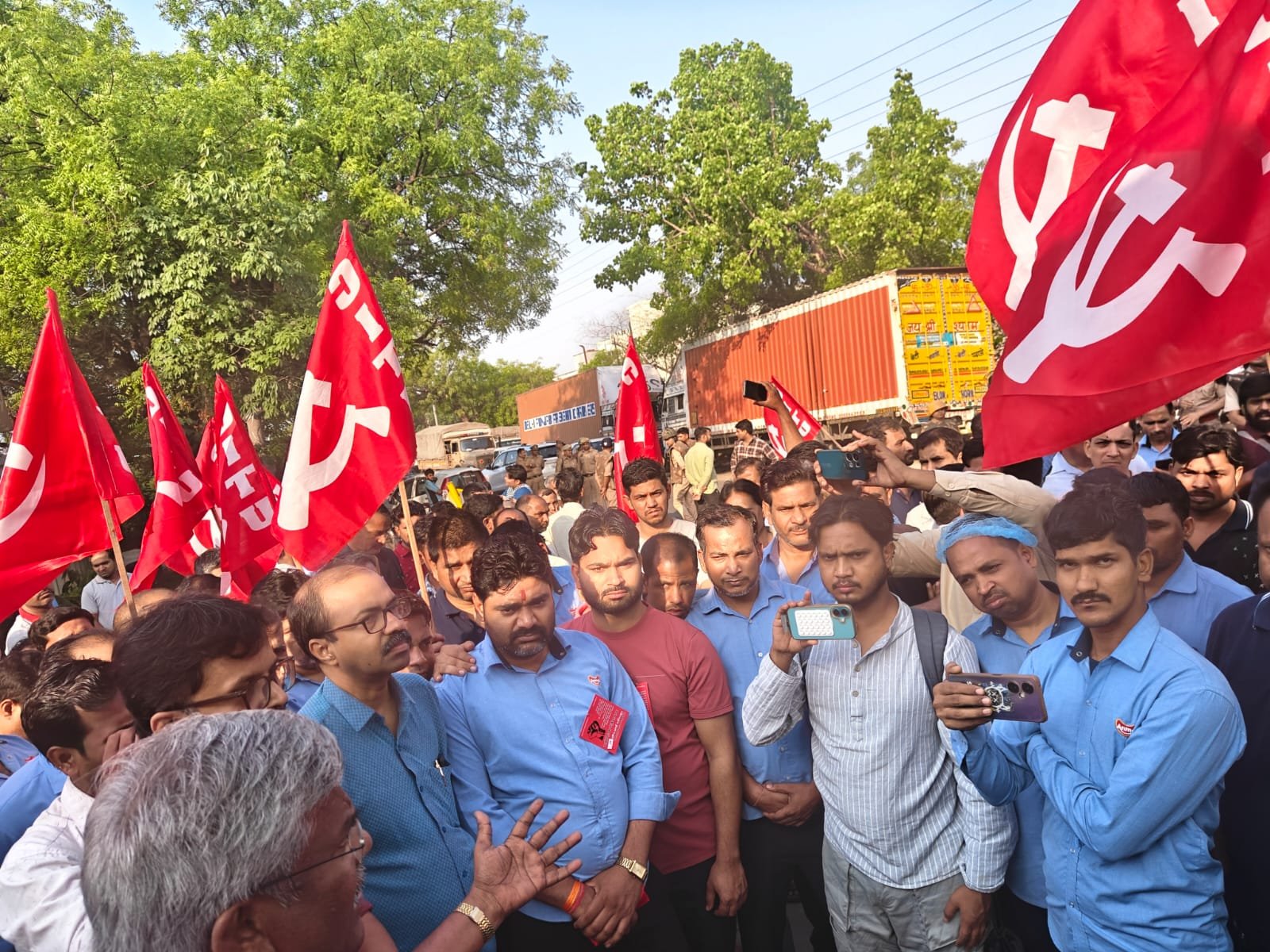
May Day procession in Maidan. Workers on the streets despite police threats.

Noida, located near the capital Delhi, is one of India's major industrial areas. From IT parks and headquarters of multinational companies to numerous garment and electronics manufacturing units, Noida is now a major employment hub. But behind these shiny high-rises and huge factories lies a history of deep deprivation. The recent series of labor protests in Noida is not just a problem of a specific region, rather, it is a miniature version of the current crisis of working people across India.

The discontent of workers in various industrial talukas of Noida is not new, but recently this anger has become more intense. The main reasons for this are — non-payment of arrears of wages, sudden layoffs without any prior notice or legal compensation, inhumane long working hours and non-payment of the minimum wage fixed by the government. The situation of contract workers or contract workers is especially deplorable.

In many factories, workers' basic rights, such as a safe working environment, clean drinking water, and sanitation, are not respected. When the minimum demands for survival are repeatedly ignored by the authorities, workers are forced to stop work and take to the streets with their backs against the wall. Although these protests are sometimes temporarily quelled by police intervention or pressure from employers, the root causes of exploitation remain unresolved.

This picture from Noida is a clear reflection of the overall situation of the working people of India. About 90 percent of the total workforce in India is associated with the unorganized sector. This large number of people do not have permanent job security, nor minimum social protection like health insurance, provident fund or pension. Since the Corona pandemic, the situation of workers in this sector has become even more dire. As their savings have dried up, many are forced to work for very low wages.

Added to this is the boom of the 'gig economy'. Millions of young people working as delivery boys, ride-sharing app drivers or temporary workers are effectively not legally recognized as employees. In corporate parlance, they are called 'partners', which means that benefits under labor laws remain beyond their reach.

Even though the prices of essential commodities are increasing rapidly in the country, the wages of workers are not increasing in line with it. As a result, their real income is decreasing and the standard of living is gradually declining. In addition, there is widespread anger among labor organizations over the new labor code brought by the government. According to them, this new rule has given too much power to employers while encouraging the policy of 'ease of doing business', which has created a fear of further erosion of workers' rights.

CITU has been opposing this law from the beginning. They have taken to the path of movement across the country. Just as the labor code does not give any guarantee of work, they are taking away the rights of the workers. They have no right to form a trade union. That is, they have to be puppets in the hands of the capitalist or owner class.
But the labor movement of Hey Market was showing the way for the labor movement of the whole world. That fight for eight hours of work is still a significant event in the labor movement of the world. As a result of that movement in 1886, the law of eight hours of work was made. But now, the BJP is trying to repeal that law with the words of Adani and Ambanis. There is no mention of eight hours of work in the labor code. The employer can make a worker work as he wishes. Today, the fight in India is to protect the rights of workers.

The workers' protest in Noida shows us that GDP growth or the establishment of large factories alone cannot be the measure of real development. Industrial development will only be meaningful when the artisans behind it, on whose sweat this economy stands, get a dignified and secure life.
@freemang2001gmail-com
Pankaj Dhar Choudhury
Pankaj Dhar Choudhury, B.A Hons. in English, M.A in English, B.ED.
He passed Madhyamik from his native village Kumar Gram Duar of Alipurduar district. He got B.A Hons. in English from Alipurduar College. He completed M.A in English from North Bengal University, Siliguri. He completed B.ED from Maldah Govt. Teachers" Training College. He has been a social media activist since 2006.
Ethan Caldwell shares thoughtful insights and reflections on life, culture, and personal growth. His work explores the intersections of creativity and experience, offering readers unique perspectives.