

An excerpt from a piece by Veeraiah Konduri in ‘Sitaram Yechury: A Towering Legacy’, edited by Veeraiah Konduri.
4 hours ago

An afternoon sometime in the middle of September 2005. While sitting with the then Tadikonda MLA, Varaprasad, regarding some family dispute of my brother-in-law, I received some calls but could not attend.
At that time, roaming option on mobile phones was a costly affair. But as I was part of Prajasakti then, they provided a mobile phone for daily reporting and communication purposes.
Finally, when I attended the call from AKG Bhavan, CPI(M) headquarters in Delhi, the message was that comrade Sitaram Yechury, a newly elected Rajya Sabha Member from West Bengal, wanted my services as his political secretary.
I was in a kind of shock and awe. Being a journalist in Delhi for Prajasakti, I had a peculiar rapport with him. As I was new to the city and had limited acquaintances, Sitaram Yechury was the chief guest at my daughter Dheera’s first birthday in Vithal Bhai Patel House.
When we thought of celebrating the birthday, who to invite was a question before me. Neeli Arjun, currently working as a government pleader in the Telangana High Court, was my senior at Prajasakti in Delhi.
He and Suryadevara Prasanna Kumar, who is currently the Legislative Assembly Secretary of Andhra Pradesh, worked out a small guest list and decided to invite Sitaram Yechury. We went to AKG Bhavan and requested his presence. He jovially said, “If I am late by any chance, we have to cut the cake again.” And we had a good laugh.
Such was the sense of belongingness he gave to those around him. Subsequently, he became my primary news source and that relationship grew to exchanges on various issues and political prospects, largely pertaining to Andhra Pradesh. Occasionally, Koratala Satyanarayana used to chip into our discussions whenever he was in Delhi for politburo meetings.
In the same year, I started covering Parliament and there was the infamous terrorist attack on Parliament. After the House was adjourned on some JPC demand, all the members were in Central Hall as per usual, and I along with a team of journalists, were sipping tea on the first floor of the building, next to the PTI office.
As soon as we realised that there was some gunfire and finally confirmed from the Parliament watch and ward staff that it was a terror attack, I ran to the Public Accounts Committee office, took the landline, called Sitaram to alert him and then called Prakash Karat to tune into the TV to follow developments.
Following that call in mid-September of 2005, I rushed to Delhi and met him. I had my own fears. I was only a person from a village and he was by then a towering personality in Indian politics. However, leaving behind all my apprehensions, I decided to join him at AKG Bhavan.
Since then, my journey with him has been a learning experience.
He took me into confidence and discussed various things, including day-to-day politics. He didn‘t hesitate to seek opinions on anything he felt was important.
Despite the fact that I was only his aide, he asked my opinion on several important things, including lines for his speeches in Parliament. It surprised me when he accepted my suggestions a good number of times.
Being editor of the party‘s central organ, People‘s Democracy, he wrote editorials every Wednesday. Subsequently, he agreed to pen a fortnightly column, Left Hand Drive, for Hindustan Times.
Each Wednesday when he started from home, he called me to give an assignment to collect material for the theme he chose to write on for that week. Similar was the case with Left Hand Drive. In that process, I learnt a lot. That was his way of imparting theoretical knowledge to young cadre.
While working at AKG Centre, Sitaram, Srinarayan, his driver Rakesh, and I were the last people to leave the office.
Even while coming down to board the car after his exhausting work, if a passerby came to shake hands with him, he spent time with them, listened to them patiently.
He was an easily accessible leader – a rare trait nowadays.
After completing his editorial each Wednesday evening, he would visit the People’s Democracy office where the editorial team would be running against the deadline to send it to the press.
To calm them down, Sitaram shared several anecdotes – from politics to sports, movies, music, arts and experiences from his personal encounters with people like Obama, Chavez, Castro, Deng Xiao Ping etc. Each anecdote was a lesson for us.
One such anecdote was about an incident when EMS Namboodripad was the general secretary of the party. A high-profile politburo team visited China for some discussions with the top officials of the Chinese Communist Party.
During the interaction, Yechury used to explain everything in detail to his counterparts. On one such occasion, Jyoti Basu, jokingly, told the team to be cautious about Sitaram. Because Sitaram spoke to each in their respective mother tongue and the other four didn’t know what he was telling their counterparts. Sitaram could engage with people of multiple languages.
During his first term in the Rajya Sabha, in one of his responses to the Presidential Address, he took the then telecom minister Dayanidhi Maran to task.
The question was about the government‘s refusal to BSNL’s request to acquire 3G technology. In that process, Sitaram culled out some figures on the dwindling BSNL network to which Dayanidhi Maran tried to retort.
Immediately after the completion of his speech, he called me from the Parliament House and asked to collect some figures. I did so. Using them, Sitaram wrote a strong letter to Dayanidhi Maran and the letter war between them ran for two or three months. Finally, with Pranab Mukherjee‘s intervention, Dayanidhi was restrained.
Those were the days of the Indian economy reeling under the subprime crisis, and the government started doling out tax concessions to industrial houses.
By then, Chidambaram took over the home ministry in the wake of the unprecedented terrorist attack on Mumbai. Sitaram was the first to work out the huge amounts of concessions doled out in the name of a stimulus programme, and lambasted the UPA government.
Pranab Mukherjee, who was watching the proceedings from home till that time, summoned the finance secretary to look for the dataset Sitaram brought to the notice of the Parliament. That was how he made the government of the day accountable.
Similarly, during his first term, Bhairon Singh Shekhawat, the then chairman of Rajya Sabha, was so impressed with Sitaram. One fine morning, his office called me for Sitaram‘s address.
I told them that he resides at Vasant Kunj and the Vice President‘s office noted down the address. I sensed something and immediately called Sitaram to apprise him. Finally, it turned out that Shekhawat wanted to pay a visit to Sitaram. Such was the respect he commanded across the political lines.
The formation of Prachanda’s government in Nepal with the support of the Communist Party of Nepal was the best example of his negotiation skills.
Those were the days when the Nepal Maoist Party, under the leadership of Prachanda and Baburam Bhattarai, was at its peak. Then there was a question before them whether to be part of Parliament or not. Finally, the Nepal Maoist Party decided to consult Sitaram Yechury about the road map.
Baburam Bhattarai and Prachanda reached Delhi. Through back-channel diplomacy, they contacted Sitaram and the meeting date and place were fixed.
On the date, Sitaram instructed me to receive them (without revealing their names, giving me just enough information to recognise them) at 11 Kastuba Gandhi Marg. That was his Parliament allotted accommodation, where my family and I too lived.
Finally, I received them and arranged the meeting. Dheera served snacks and tea. Sitaram came along with Prakash. During the meeting, I came to know who they were and what the agenda was.
Once I realised what was happening there I left the scene. He told me what it was only after they departed. What had happened subsequently is part of history.
The story of two meetings that never took place was interesting. One with the then US Ambassador to India and the other with Sri Sri Ravi Shankar.
When the US insurance industry was trying for a relaxation in the FDI cap in the insurance sector, the industry representatives lobbied hard with the finance ministry.
Without the clearance of the UPA–Left Coordination Committee, such important policy decisions could not be made.
Finally, some Machiavellian tacticians in the finance ministry directed the US insurance companies to get consent from the Left, primarily from CPI(M) through Sitaram.
They sought an appointment and, under his instructions, I refused them politely. One day the US ambassador‘s office called me and sought time for the ambassador. After discussion with Sitaram, I fixed the time.
Finally, when the date approached, the ambassador’s political secretary insisted Sitaram come to the embassy. But he declined to visit embassy and I wrote back to the PA to the ambassador in harsh terms, terminating the meeting. This episode led to a rumour campaign against Sitaram also. I was in the middle of this and bore witness to what had happened.
Another such meeting was with Sri Sri Ravi Shankar. His office also wanted Sitaram to visit his place but we insisted he visit AKG if Sri Sri Ravi Shankar was interested. Finally, that was also terminated. These two incidents show how Sitaram stuck to his fundamentals and withstood Machiavellian tactics.
As head of the CPI(M)’s international department, he was also good at international relations. Over the last three decades, his voice has been considered important by MEA (Ministry of External Affairs) officials on a number of occasions.
On one such occasion, Shiv Shankar Menon, National Security Advisor under the UPA, visited AKG to take Sitaram’s opinion over some issues related to China.
He used to be a regular panellist at the Mussoorie IAS Academy, delivering lectures on various aspects to trainee IAS officers. He was also a regular speaker at the Defence College and the Sardar Vallabhai Patel Police Academy in Hyderabad. That was the reputation he commanded in policy circles.
Though the country forgot, it was because of him that India had not fallen into the trap of nuclear energy. Even though the then UPA government could sign the nuclear energy deal despite strong resistance from the CPI(M), it did not operationalise simply because of Sitaram. He opposed the bill which the UPA2 was pushing for.
If Sitaram had not been in the Rajya Sabha then, the nuclear limited liability would have been an Act by now. He wrote more than 10 columns in Hindustan Times explaining the disadvantages of nuclear energy for a country like India.
On the art and culture side, his interest in old classical Hindi songs and movies was as good as his interest in politics. Once upon a time, he collected all the gramophone records of Mohammad Rafi and some other singers. He loved Beethoven a lot. So much so that it was played even as he drew his last breath.
His article in Hindustan Times on Ram Sethu controversy revealed how deep his understanding on ancient India’s history and culture was. Similarly, his article on multiple identities in the age of globalisation was an eye-opener.
Last but not the least, he valued people, their sentiments and emotions. That was an unusual trait for a Communist of his nature.
He even visited my small house in my village, Lingaraopalem, after my mother died. That showed the best of his human side. For a person of his stature, he could have conveyed his sympathies but he chose to visit my house when he got the opportunity.
Every interaction of ours left a lasting impression on me. Sitaram was a friend, a philosopher and a guide. He was the best Marxist I ever met in my life. Capturing his life in one article is impossible.
Veeraiah Konduri worked as Private Secretary to the Department Related Parliamentary Standing Committee on Tourism and Transport, and also a private secretary to Sitaram Yechury. He practises as an advocate in Hyderabad.
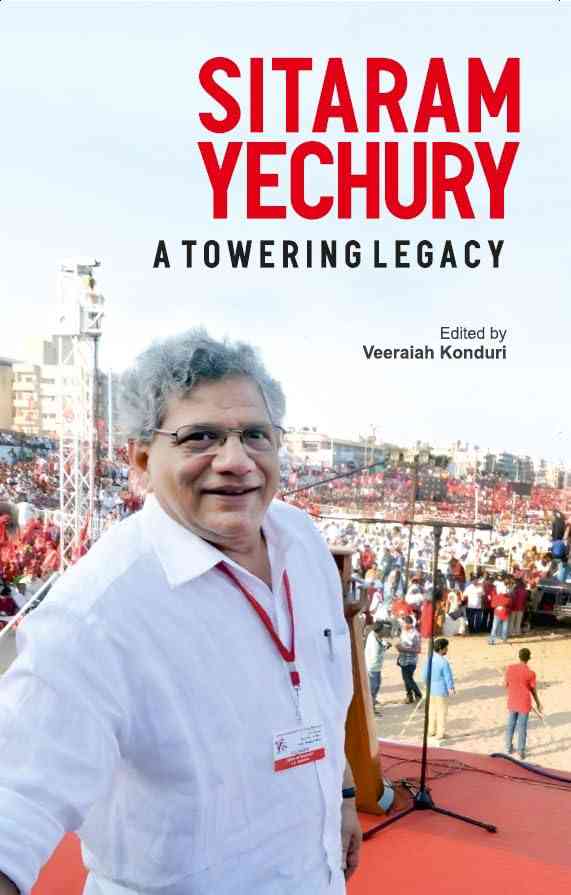
Excerpted with permission from ‘Sitaram Yechury as I Knew Him: A Confidante’s Memoir’ by Veeraiah Konduri in Sitaram Yechury: A Towering Legacy, edited by Veeraiah Konduri, New Era Publications.
Excerpted with permission from Sitaram Yechury: A Towering Legacy, Veeraiah Konduri, New Era Publications.
Sourced from Scroll.in
@freemang2001gmail-com


