

The scheme will be launched under a central law. But unlike the 100 Days Work Act (MGNREGA), most states will bear 40 percent of the cost of wages.
In fact, the new law, renamed 'VB Ji Ram Ji', will shift a large portion of the financial responsibility for the legal right to work in villages onto the state.On Tuesday, the Vikas Bharat Rojgar and Ajeevika Mission (Gramin) Bill (VBG Ram Ji), 2025, was introduced in Parliament to replace the popular MGNREGA in the rural area.
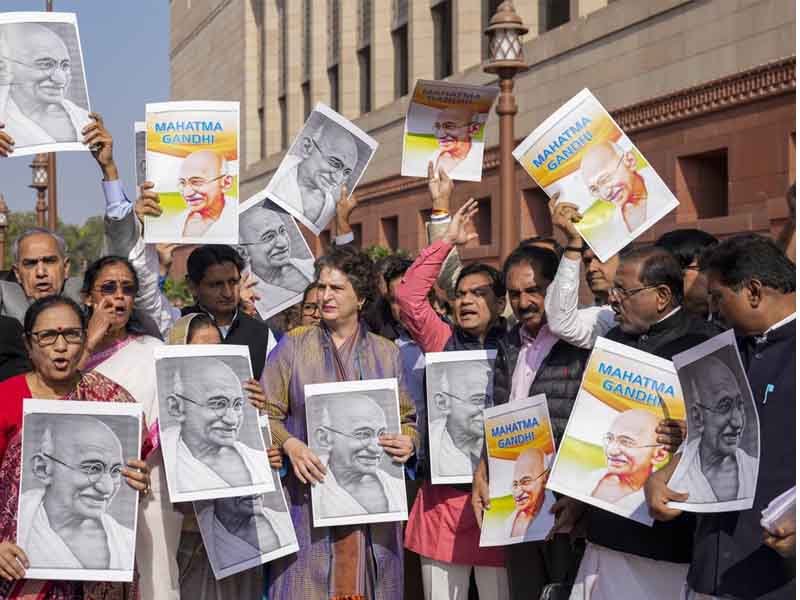
Opposition MPs protested loudly. Left-wing MPs demonstrated outside the Parliament building in protest against the cancellation of MGNREGS. The bill provides for a 125-day guarantee of work.
The opposition says that this could have been done by amending the existing law. There is also a demand to provide 200 days of work. In fact, the Narendra Modi government is trying to destroy the legal right to guaranteed work in villages.
Union Minister Shivraj Singh Chouhan introduced this bill today. It states that the states will have to implement the projects as per the law within six months of the passing of the bill.Till now, this responsibility was with the Centre. Therefore, soon after the bill was introduced, the opposition parties protested against the bill in the Lok Sabha. They also protested against the removal of Mahatma Gandhi's name from the bill.
Union Minister Shivraj Singh Chouhan, while introducing the bill, said that the government respects not only the ideals of Mahatma Gandhi, but also his policies. In addition, he also said that compared to the previous government, the Modi government cares much more about the development of rural public life.
As various opposition parties opposed it, it was decided to send it to the relevant parliamentary committee for detailed review. The new bill states that the government will provide a wage guarantee along with 125 days of employment in a financial year.
According to the 'VB Ji Ram Ji, 2025 Bill', the Centre will bear 60 percent of the expenditure on wages. The remaining 40 percent will have to be borne by the states. Only in Jammu and Kashmir, North Eastern states, and Hill states, this ratio will be 90:10.The Centre will bear the entire wage cost only in a few Union Territories like Andaman and Nicobar, which do not have a legislative assembly.
According to the current MGNREGA, the entire wage cost has to be borne by the Centre. The state has to pay the allowance for job card holders who do not get work. In addition, the state has to bear 25 percent of the cost of materials and equipment. And the administrative cost has to be borne at the state level.
CPI(M) MP John Brittas said that the very concept of legal right to job security is being dismantled. Congress MP and Leader of Opposition in Lok Sabha Rahul Gandhi said that the current law has the provision to plan work from the Gram Sabha. This project is being completely centralized under Narendra Modi’s leadership, yet a large portion of the financial responsibility is being placed on the state.
@freemang2001gmail-com


