

The problem with Tipu Jayanti is not that Tipu’s memory should be shunned. Quite the contrary: he deserves sustained study
Illustration for representation
Dr Vikram Sampath Updated on: 22 Nov 2026, 6:06
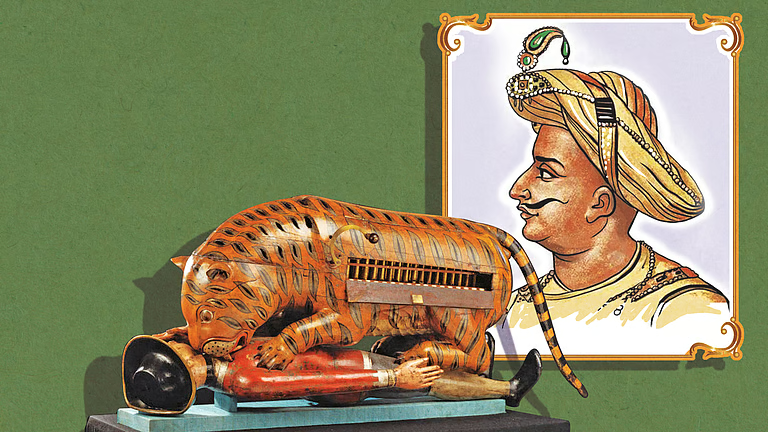
There is a curious artefact in London’s Victoria and Albert Museum: a life-sized mechanical tiger mauling a European soldier. When it was in working order, turning its handle made the tiger growl, while the victim emitted agonised cries. Known as Tipu Sultan’s Tiger Toy, it was once housed in Tipu’s bedroom in his Srirangapatna palace. More than two centuries after its owner’s death, the contraption has acquired an unlikely afterlife. Every November, as Karnataka approaches Tipu Jayanti, the tiger seems to stir again—not in a museum gallery, but in the state’s noisy political arena.
The latest round began with the Tehrik-e-Khudadad, urging Chief Minister DK Shivakumar to restore the official celebration of Tipu Sultan’s birth anniversary on November 10, change school textbooks, and commemorate the ruler. Politicians on both sides quickly rallied for and against.
I have been writing about the contradictions surrounding Tipu since 2008. Nearly two decades later, and following the publication of my biography, Tipu Sultan: The Saga of Mysore’s Interregnum (1760-1799) in 2024, the arguments remain remarkably familiar. One side invokes a heroic resister of British expansion; the other recalls a ruler associated with religious persecution and forced conversions. Each side has its preferred version of Tipu, and each is selective about the historical record.
Tipu was undoubtedly a formidable adversary of the East India Company. The Anglo-Mysore Wars were among the most consequential military confrontations of 18th-century India. His father, Haidar Ali, led Mysore through the first two wars, in which Tipu also participated. As ruler, Tipu fought the third and fourth but lost all wars to the British. The military innovations of Mysore, particularly its use of rockets, caused serious difficulties for British forces. The Treaty of Mangalore in 1784, which concluded the Second Anglo-Mysore War, was a remarkable diplomatic achievement for Mysore. Tipu’s resistance deserves its place in the history of opposition to the East India Company.
But to describe him as a freedom fighter who fought for the liberation of India is to impose a 20th-century vocabulary on an 18th-century ruler. Tipu was fighting to preserve and expand his own kingdom, its sovereignty, and his dynastic ambitions. He sought alliances with powers that could help him against the British, including the French court under Louis XVI. His embassy to France secured an audience with the king in 1788. The French, too, were a colonial power. An alliance with them was hardly a programme for Indian national liberation. He also reached out to the Ottoman court, Persia and Zaman Shah of Afghanistan, seeking support from Islamic powers to invade India and establish an Islamic Caliphate.
The other side of Tipu’s record is considerably more difficult to accommodate within the celebratory narrative. His own correspondences, Persian records, contemporary accounts and regional histories document campaigns involving coercive conversions, violent deportations, and destruction of innumerable places of worship. The communities of Malabar, Coorg, and Canara, including the Nairs, Kodavas, and Mangalore Christians, have preserved memories of these episodes across generations. His letters boast of converting even dead Kodavas! The persecution of Mandyam Iyengars—slaughtering 700 men, women and children of that community—is another deeply disturbing chapter. These accounts cannot simply be dismissed as British propaganda, particularly when some of the most troubling evidence comes from Tipu’s own letters and proclamations. Hindu-Mysore was Islamised as Sarkar-e-Khudadad, with Persian replacing Kannada and cities taking on Islamic names.
There is, of course, another part of the record. Tipu, like his father, corresponded reverentially with the Shankaracharya of Sringeri and extended assistance to the math after it was attacked by Maratha Pindari irregulars in 1791. He also made some grants to Hindu religious institutions. These facts deserve acknowledgement. But they do not automatically cancel the evidence of largescale persecution elsewhere. A ruler could patronise one religious institution, for reasons of devotion, political calculation or both, while pursuing coercive policies against other communities.
My research took me through archives in India and abroad, and through records in Persian, Kannada, Marathi, and Malayalam, alongside British, French, and other contemporary accounts. The picture that emerges is of a ruler who was militarily ambitious, administratively energetic and fiercely opposed to the British. But they also reveal an authoritarian, bigoted ruler whose religious policies and treatment of other communities cannot be glossed over. His dreams, letters, diplomatic correspondence, and administrative orders offer glimpses into a political imagination inseparable from his theological convictions.
The problem with Tipu Jayanti is not that Tipu’s memory should be shunned. Quite the contrary: he deserves sustained study. The problem begins when the State is asked to turn a contested historical figure into an official object of veneration. The Congress government introduced the state-sponsored Jayanti in 2015; the BJP government discontinued it in 2019. The pendulum has since remained caught between celebration and repudiation. The counter-narratives that surfaced before the 2023 Karnataka elections, including the unsubstantiated story of Uri Gowda and Nanje Gowda as Tipu’s killers, demonstrated how readily history can be recruited for electoral purposes.
Governments cannot erase Tipu from history, any more than they can compel people to admire him. Nor should the historical record be rewritten to make him palatable to present-day sensibilities. The same standards must apply to every ruler: achievements and violence must be examined, even when the evidence unsettles our preferred narratives.
The mechanical tiger in London was designed to keep alive the memory of a British enemy. In Karnataka, its modern counterpart is wheeled out by political parties whenever the calendar approaches November 10, more so if elections are fast approaching. Perhaps it is time to put the toy back in its case and return Tipu Sultan to where he belongs: the archives, and allow historians to do what they are meant to do: examine Tipu’s life and reign without the demands of contemporary politics. After all, a society confident in its history need neither manufacture heroes nor suppress its uncomfortable chapters.
vikram.sampath@fihcr.com
https://www.newindianexpress.com/magazine/2026/Nov/22/the-spectre-that-haunts-every-november?utm_source=firefox-newtab-en-intl
@freemang2001gmail-com


