

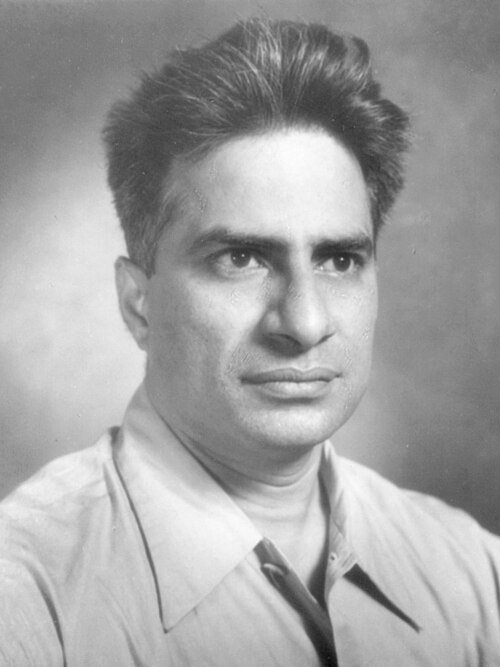
Damodar Dharmanand Kosambi (July 31, 1907 – June 29, 1966) was an exceptional scholar; he embodied the multidisciplinary expertise and profound, expansive erudition characteristic of the pioneers of the Renaissance. Yet, the most significant aspect of Kosambi’s life was that he was never a scholar who remained confined to an ivory tower. His thoughts were centered on people and their liberation from exploitation.He raised objections—based on the practical application of statistics—to the government’s unilateral decisions regarding the site selection and construction of dams in the country. To prevent seasonal fatalities in the then-city of Bombay, he recommended implementing an anti-typhoid campaign for three weeks just before the onset of the monsoon. He demonstrated how at least 500 premature deaths in Bombay could be averted annually.During an invited visit to Beijing, China, he recommended the application of advanced scientific methods for forecasting grain production and controlling the quality of manufactured goods. Zhou Enlai and the Chinese writer and statesman Guo Moruo were among the audience members present during his discussion.Three-quarters of a century ago, he urged his country’s government to prioritize solar power generation over the highly expensive option of nuclear energy as an alternative power source. Such was his foresight.
As a mathematician and statistician, he also made significant contributions to the field of genetics; furthermore, his work played a pioneering role in the study of numismatics in our country. His groundbreaking contributions to modern historiography, along with his profound analyses of Indology, linguistics, theology, and the caste system in Indian history, earned him a distinguished place in the global intellectual community. Above all, he was a Marxist historian. Friday marked his 120th birth anniversary.
He was born in Kosben, Goa. His father, Dharmananda Kosambi, was a renowned Buddhist scholar who taught at Harvard University in the United States for many years. It was from his father that he drew the primary inspiration for his pursuit of knowledge, as well as inheriting his father’s multifaceted intellect and sense of humanism. He received his formal schooling in Pune. Later, he accompanied his father to the United States, where he enrolled in the Cambridge Latin School; after completing his studies there in 1925, he began his undergraduate education at Harvard University.He graduated from there in 1929 with great distinction. He demonstrated proficiency in mathematics, history, and languages such as Greek, Latin, German, and French.
While studying at Harvard, he came into contact with eminent mathematicians George Birkhoff and Norbert Wiener. Upon returning to the country that same year, he joined the Department of Mathematics at Banaras Hindu University; as his reputation as a mathematician grew, he received an invitation from Aligarh Muslim University. He taught there for a year as well. In 1932, he decided to settle permanently in Pune and joined Fergusson College as a professor in the Department of Mathematics.It is worth noting that his father had long served as a professor in the Department of Pali at this very college. During his fourteen-year tenure at Fergusson College—which lasted until 1946—his mastery across various fields of scholarship established him as a great scholar and thinker of modern India. Subsequently, he joined the Tata Institute of Fundamental Research in Mumbai as a Professor of Mathematics and retired from the institution in 1962.
The world-renowned Irish scientist Professor J.D. Bernal highly praised his contributions to the field, achieved through the innovative application of mathematical methods across various branches of the social sciences. His 1944 work on chromosome mapping in genetics significantly advanced global theoretical research in the field at that time. He successfully leveraged his expertise in genetics. Consequently, Kosambi moved beyond merely theorizing about the cultural history of the various clans—or more precisely, the tribal communities—of ancient societies, bringing it instead into the realm of practical application. As a result, the cultural diversity and behavioral characteristics of India’s anthropological groups were revealed in the light of objective historical evidence.
In 1956, a groundbreaking book by Kosambi was published. Upon the release of this work—titled An Introduction to the Study of Indian History—students, teachers, and researchers of history began to say that a new door had opened for viewing and understanding the history of India.And Kosambi himself began the preface to the first edition of this book thus: ‘This book does not claim to be a history of India; it is merely a modern attempt to understand Indian history—written in the hope that the reader might be inspired to understand that history for their own sake, or at least be able to view the country with greater empathy and insight.’
He sought to convey to the reader that historical examples are simple and straightforward; one can find them in the lives and behavior of neighbors or in the remnants of antiquity that have survived in one’s own region. In other words, Kosambi held the view that the combination of genuine fieldwork and analytical insight constitutes a primary means of knowing and understanding history. He firmly believed that viewing something as self-evident, through the lens of blind faith, or via emotionally charged preconceptions does not—whatever else it might be—amount to history.
He sought to convey this message with great sincerity, yet grounded it firmly in logic: history is not merely a sequence of disjointed events, but something created by humans to meet the necessities of daily life. He wrote, “A society formed by a multitude of people comes into existence only when those individuals become interconnected in some way. This essential relationship is not based on racial theory; rather, it is far more expansive—forged through the processes of production and the mutual exchange of goods.”
“The characteristics of a specific society are defined by what it deems essential: who holds possession of goods? Who produces them, and with what materials? Who subsists on the production of others—and by what right: divine or legal?” He argued that belief in God and the laws themselves are merely by-products of society. He went on to ask, “Who owns the means of production, the land, and the bodies and souls of the producers? Who controls the distribution of the surplus, or the volume and nature of supply? Society is bound together by the ties of production.”
To those who believe that materialism destroys human values—arguing that human existence transcends mere sustenance and that history and society depend on the individual’s control over their eternal soul—Kosambi offers a counterpoint: one cannot survive without sustenance; indeed, it is essential for keeping the soul (if such a thing exists) anchored within the body. Far from destroying human values, materialism actually demonstrates how they are linked to contemporary social conditions.
He observes that he could have learned even more than he did from professional historians had they not overlooked the paramount importance of fieldwork in the study of Indian history. This fieldwork comprises three interconnected components: archaeology, anthropology, and linguistics.In the preface to the revised edition of the book, he writes, “For each of the three sections, it is essential to possess some preliminary knowledge of the environmental context of the specific locale, the ability to master local speech patterns, and the capacity to win the trust of both the tribal people and the farmers. Each instance of fieldwork necessitates the development of a methodological framework and analytical approach based on the very lines of inquiry being pursued.”
Forcing observations into some immutable, preconceived mold is extremely detrimental. The art of asking the right questions in the right way is something that must be mastered on the ground; it cannot be taught. Regardless of the vehicle used to reach a particular region, the actual work of a survey can only be accomplished on foot. The book in question can be described as the culmination of this line of thought and intellectual pursuit.
A man of great stature with a profound belief in internationalism, he contributed significantly to society and his homeland, and had much more to offer; yet, his life came to an end at the age of only fifty-nine. In that time, he played a pivotal role in the global peace movement and prioritized the friendship between India and the Soviet Union. Notably, he dedicated his book on the study of Indian history not to any individual, but to the spirit of Indo-Soviet amity.
Following the death of the legendary philosopher Debiprasad Chattopadhyaya, another iconic Marxist thinker and distinguished leader of the communist movement, E.M.S. Namboodiripad, wrote a tribute noting that just as the multifaceted intellect of philosopher Debiprasad made significant contributions to the field of Indian philosophy, the multifaceted genius of D.D. Kosambi similarly enriched the realms of science and history in the country. In his view, therefore, Debiprasad could be compared only to Kosambi.
TO BE CONTINUED—-
@freemang2001gmail-com


