

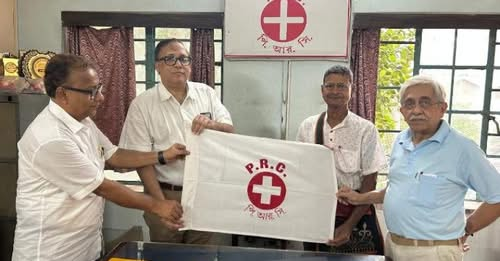
Journalist Mir Afroz Zaman writes about his experience with the historic People’s Relief Committee (PRC) after traveling from Dhaka to Kolkata for medical treatment and subsequently returning home. He explains why the PRC—located at 26/C Dilkhusha Street, Park Circus, Kolkata—is becoming a trusted destination for affordable healthcare among marginalized communities in West Bengal. Healthcare is a fundamental human right; yet, due to the ever-rising costs of medical treatment, many low- and middle-income marginalized families in West Bengal remain deprived of quality healthcare.Due to the limited capacity of government hospitals and the high costs associated with private hospitals, many people are unable to access timely medical treatment. Against this backdrop, the People’s Relief Committee (PRC)—located on Dilkhusha Street in Kolkata—has long served as a symbol of reliability for thousands of people by providing affordable healthcare services.
The PRC, with its rich legacy, is not merely a voluntary organization but part of a social movement rooted in public health. Established with the aim of standing by the people during famines, floods, and humanitarian crises prior to independence, the organization has over time expanded its scope to include healthcare, relief, rehabilitation, and social development activities.
Today, the center located at 26/C Dilkhusha Street in Kolkata’s Park Circus area provides medical care to hundreds of patients daily at a low cost. A large proportion of those seeking treatment consists of low-income laborers, small business owners, senior citizens, and retirees for whom accessing expensive private healthcare is difficult.
PRC’s health center provides modern medical services at an affordable cost, with outpatient (OPD) services managed by specialist doctors on a regular basis. In addition to general medical care, services are offered across various departments, including cardiology, pediatrics, ophthalmology, orthopedics, gynecology and obstetrics, and dermatology.
Additionally, facilities are available for pathology services, X-rays, ECGs, echocardiography, ultrasonography, dialysis, and various diagnostic tests at relatively low costs. Measures are also in place to assist patients with expensive tests, ensuring that treatment is not discontinued due to a lack of funds. A key feature of the PRC is that it operates healthcare services based on a sense of social responsibility rather than a commercial mindset.
Beyond the main center on Dilkhusha Street in Kolkata, PRC conducts healthcare operations in Howrah, Uttarpara, Baghajatin, Halishahar, Udaynarayanpur, and Berhampore. Through these centers, efforts are being made to extend medical services to the general public outside the city as well.
Doctors, social workers, and volunteers have long been working to expand healthcare services under the leadership and humanitarian initiatives of PRC. Dr. Fuad Halim, the General Secretary of PRC, has played a pivotal role in advancing public health-oriented initiatives through his long-standing involvement in the organization’s healthcare activities. Alongside him, patients receive care daily through the collective efforts of numerous doctors, nurses, health workers, and volunteers.
The organization gained renewed prominence for standing by people during the COVID-19 crisis. Throughout the lockdown, it supported thousands of individuals by distributing food and medical supplies, providing medical consultations, and offering emergency humanitarian aid. Their humanitarian efforts continue even amidst ongoing disasters and crises.
Why is the PRC important? According to public health experts, the importance of non-profit initiatives like the PRC is steadily growing in terms of reducing out-of-pocket health expenses and ensuring medical care for the poor. Beyond providing healthcare services, such institutions play an indispensable role in fostering health awareness, preventive care, and social solidarity.
According to experts, several measures could be prioritized to further strengthen the functioning of the PRC: establishing low-cost health centers in every district; delivering specialist medical care to remote areas via telemedicine; implementing special support programs for patients suffering from cancer, kidney disease, and heart conditions; expanding maternal and child health programs; and increasing the use of digital health records and modern diagnostic technologies.Initiatives are being taken to establish health insurance and community-based health funds. Efforts regarding regular health camps, blood donation drives, and health awareness campaigns are being intensified. Representing an alternative model of development—at a time when public concern over healthcare costs is rising in West Bengal—PRC has demonstrated that it is possible to provide quality healthcare at a low cost through a combination of social initiative, efficient management, and humanitarian commitment.
This institution on Dilkusha Street is no longer merely a health center; it has become a symbol of hope for many. Their journey is driven by the commitment to ensure that no patient is deprived of medical treatment due to a lack of funds. At a time when healthcare is becoming increasingly expensive, PRC’s experience demonstrates that a people-oriented, non-profit, and socially responsible healthcare system can indeed be effective.Those involved in healthcare anticipate that this initiative to keep the doors of medical treatment open for marginalized people will expand further in the future.
@freemang2001gmail-com


