

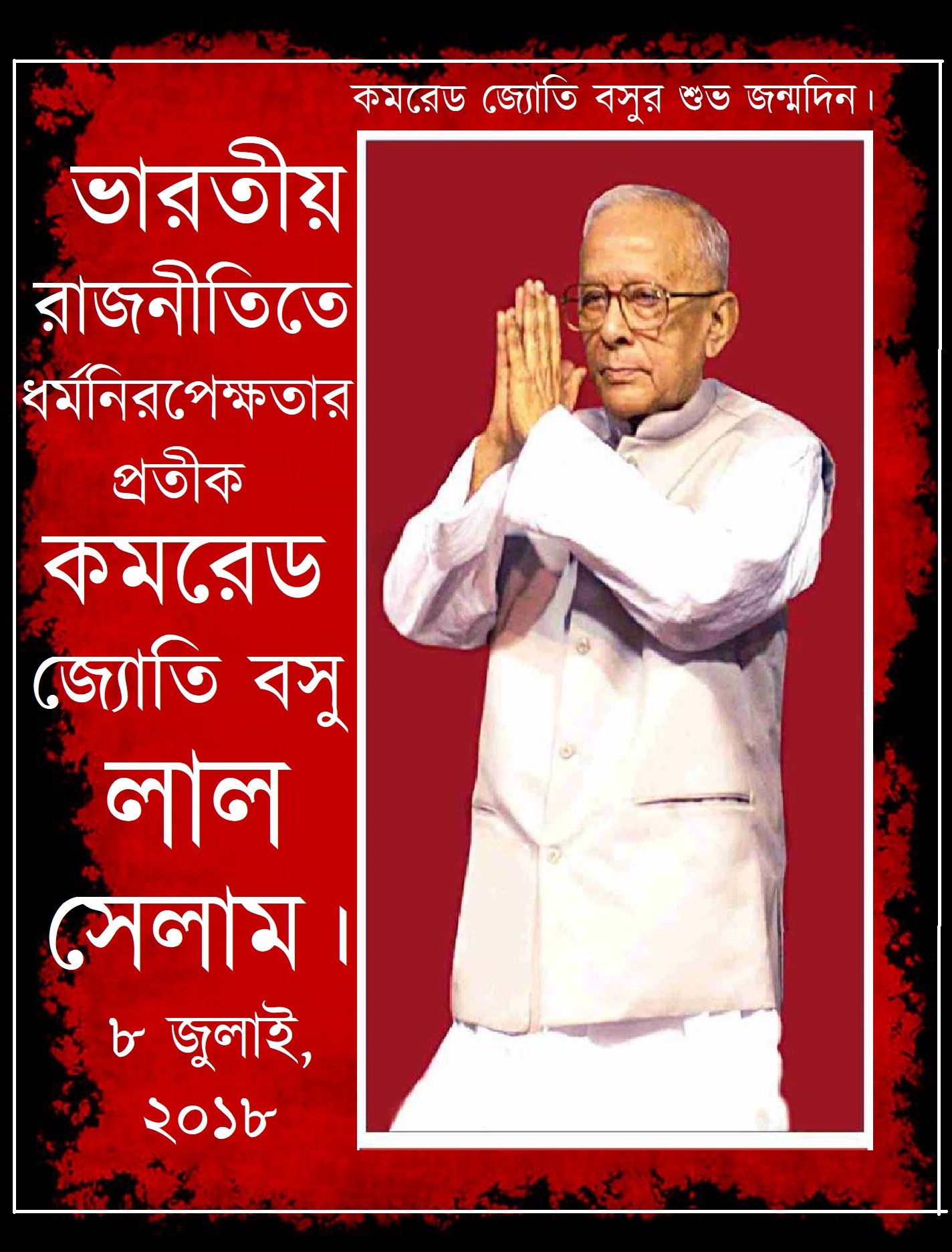
We did not start from scratch. The Left Front government that has been in power in this state for thirty-three years is the outcome of a continuous process of mass movements, and Jyoti Basu was the foremost leader of those movements. It is impossible to confine Jyoti Basu within the limits of a single epithet or the description of any one event. He is the embodiment of the country’s Leftist movement; we have seen him rise to prominence amidst the waves of numerous struggles and witnessed his commanding presence in the face of great adversity. He was regarded as a living legend in politics. He commanded respect both at home and abroad. He had been associated with the communist movement since the 1940s. He always enjoyed the love and goodwill of the people. I knew him as a party leader; he was a beloved leader among workers and middle-class employees, and was cherished by the farming community. His administrative acumen was beyond question. Even our current industrial policy is the product of his vision.
Beyond all this, I have known Jyoti Basu as a man of extraordinary courage. The mere thought of him instantly brings back a multitude of vivid memories. From these memories emerge moments that spark with intensity, revealing the resolute figure of Jyotibabu. He faced multiple attacks: an attempt was made on his life in Patna; Congress supporters attacked him in Baruipur; and Naxalites assaulted him in Basirhat. Yet, I never saw him shaken by any of these incidents.
I am reminded of a particular day right now. Jyoti Babu was on his way to hold a meeting in Birati. I was accompanying him. It was 1971. Near Dum Dum Airport, a barrage of bombs was being hurled to stop us; there was utter chaos. Habu-da, who was driving our car, was momentarily taken aback. Jyoti Babu simply said, “We cannot stop. We must move forward.” The car moved on. We reached the meeting venue amidst the bombing and turmoil. The meeting took place. Many others have witnessed similar incidents. I, too, have so many memories—so many.
I would like to mention another day—the day of the 1972 election. They conducted the vote by deploying the police and the military, and by unleashing terror through miscreants. Jyoti Basu, the candidate for Baranagar, tried to stop this rigging alongside party workers and leaders. However, by around noon, he realized it was impossible; he understood that the rigging was premeditated and nothing could be done about it. Jyoti Babu withdrew his candidature and went straight to the party office, where Promode Dasgupta and P. Sundarayya were present. Similar reports are coming in from many parts of the state. Our candidates and workers are being attacked, and people are unable to go out to vote. After reviewing the situation, I realized that the verdict has been altered through terror and fraud.
After the Left Front government was formed in 1977, the most crucial task was to establish democracy and restore law and order. Pramod Dasgupta and Jyoti Basu publicly declared that there would be no retaliation for the actions of the previous regime. One of the Left Front government’s major initial steps was the general release of prisoners; our party workers, as well as Naxalites, were set free. Siddhartha Shankar Ray had imprisoned many mid-level Congress leaders as well due to infighting within the party; they, too, were released. Naxalite leader Kanu Sanyal was released at that time. However, he could not be set free because there were pending cases against him in Andhra Pradesh. Carrying a letter from Jyoti Babu, I met the Chief Minister of Andhra Pradesh. He said it was impossible—he could not release Kanu Sanyal. I had to return without success.
Jyoti Basu made it clear from the very first day that the Left Front government was different. Upon entering the Writers’ Buildings after taking the oath as Chief Minister, he stated that the government would not be run from the Writers’ Buildings. Did that mean no work would take place there? Not at all; it meant the government had to reach out to the common people. This was the core philosophy of the Left Front government, and that is precisely what we have been doing. The very next year, Panchayat elections were held, utilizing the existing legislation. The government truly reached out to the people—across districts, blocks, and villages. Power was vested in the people, and work began with tremendous vigor. We realized the true extent of this strength that very year when devastating floods struck; we were able to tackle the situation precisely because the new Panchayats had stepped in to help. The administration alone could not have accomplished this task.
At that time, the municipalities in the towns were also revitalized. The Congress had dissolved most municipalities and was running them through appointed administrators; we restored these stagnant, bureaucrat-run bodies to the people. Behind the immense success of the Panchayat system in our state—which later became a model for the entire country—lies a vibrant history of mass movements. It was against the backdrop of the United Front governments of 1967 and 1969 and widespread land struggles that the redistribution of land began in 1977. Hundreds of acres of land held by *jotdars* (large landowners)—land that exceeded the legal ceiling and was backed by the political clout of the Congress party—passed into the hands of marginalized people. The rights of *bargadars* (sharecroppers) were established. These measures yielded results in the agricultural sector; crop yields rose steadily. The high agricultural productivity for which we now rank among the leaders nationwide actually had its origins back in 1977.
However, we gradually came to realize that progress in agriculture or success in small and medium-scale industries alone could not bring about the state’s overall development. We had to stage a turnaround in the industrial sector and boost employment. The state had suffered long-standing neglect and had fallen behind. Then, an opportunity arose: thanks to the policy of liberalization, the central government abolished the licensing system.
Previously, permission from Delhi was required for large-scale industries. At that time, Jyoti Basu repeatedly emphasized the need to advance industrialization. The industrial policy that exists today was actually formulated in 1994; its core premise is the necessity of industry for the sake of development. The government cannot achieve this alone; private capital is also required. While private entities will certainly make a profit, we have a need for employment generation. Our industrial policy is founded on this very principle. Gradually, the credibility of this policy grew. Investments flowed in. We moved forward along this path. The industrial landscape also underwent a gradual transformation. Jyoti Basu placed immense importance on another aspect while formulating the industrial policy: safeguarding the interests of the working class. He was also a supreme leader of the labor movement and kept a vigilant eye on ensuring that the interests of the workers were not compromised.
One more point must be mentioned. During the Congress era, education in this state was severely neglected. Teachers received neither adequate pay nor respect. There were numerous movements; Jyoti Babu participated in these struggles and even went to jail. After the Left Front government came to power, universal education became a top priority. Education was made free up to the Class XII level. The condition of teachers improved, and their status was elevated.
Many such instances could be cited. I have observed Jyoti Basu both as a politician and as an administrator; in both roles, I saw him handle situations with courage. He expressed himself and the situation at hand with such ease. His decision-making ability was remarkably fluid, and he was capable of making the right decision at the right time—whether regarding law and order or other matters. He would make swift decisions during times of communal tension, and we witnessed just how unerring those decisions were.
Jyoti Basu was one of the key architects behind the formation of the Left Front and the Left Front government. The Left Front did not emerge overnight; it was the product of a long history of struggle. It can be said that the Left Front was the outcome of numerous mass movements dating back to the 1950s—movements in which Jyoti Basu stood at the forefront. It was through this very process that the foundation for Left unity across the country began to take shape. The quest for an alternative continued, driven by the currents of movements involving workers, peasants, the middle class, and the common people—all under his leadership. The struggle for an alternative continued at the national level as well. He steered the movement towards a foundation of Left-Democratic unity. Jyoti Babu made an extraordinary contribution to organizing the Left and democratic movement across the country. I always observed Jyoti Basu being proactive about the need to adopt various interim measures; he knew how to effectively capitalize on the prevailing situation.
The search for a genuine alternative is still ongoing. That is why I said we did not start from scratch; there is a continuity running through our ideas, movements, and struggles. This is where Jyoti Basu’s position lies. Our goal is to move further ahead. It is the people who will judge whether we have truly advanced or regressed.
(This article by Buddhadeb Bhattacharjee was published in the *Ganashakti* newspaper on January 24, 2010. It is being republished on the occasion of Jyoti Basu’s 113th birth anniversary.)
Jyoti Basu was one of the key architects behind the formation of the Left Front and the Left Front government. The Left Front did not come into existence overnight; there is a long history of struggle behind it. Jyoti Babu made an outstanding contribution to organizing the Left and democratic movements across the country. I always observed him being proactive whenever various interim measures needed to be adopted; he knew exactly how to effectively leverage the prevailing situation.
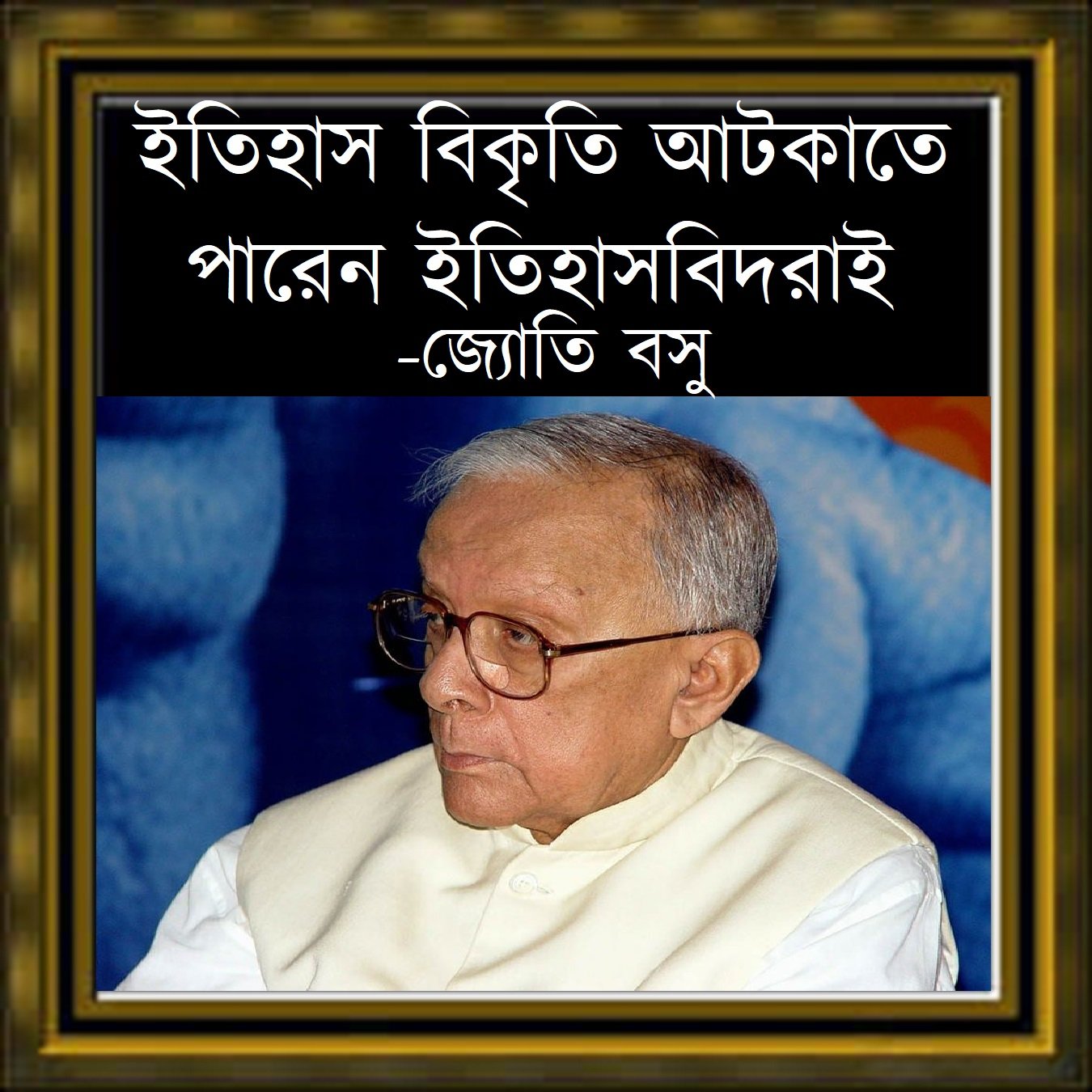
Source : দেশের বামপন্থী আন্দোলনের মূর্ত প্রতীক–বুদ্ধদেব ভট্টাচার্য
Translated and published by me.
@freemang2001gmail-com
‘শুধু বক্তৃতা-ই নয়, ১৯৪৬ সালের ১৬ আগস্ট ভয়ঙ্কর দাঙ্গা পরিস্থিতিতে নারকেলডাঙ্গার শ্রমিক লাইনে নিজে রাতপাহারা দিয়ে বুক আগলে রক্ষা করেছিলেন শ্রমজীবী মানুষকে। পরদিন দাঙ্গাবিধ্বস্ত এলাকায় আটকে পড়া পার্টিনেতা, কর্মীদের উদ্ধার করতে পৌঁছে গিয়েছিলেন সেখানে।’ কমরেড জ্যোতি বসুর জন্মদিনে লিখছেন, অজয় দাশগুপ্ত।
🔗 বিস্তারিত পড়ুন:
https://marxbadipath.org/article/uncompromising-on-secularism/893
https://marxbadipath.org/article/uncompromising-on-secularism/893
মার্কসবাদী পথের ওয়েবসাইটে প্রকাশিত।
Jyoti Basu, Secularism, CPIM
Marxbadipath
@freemang2001gmail-com


