

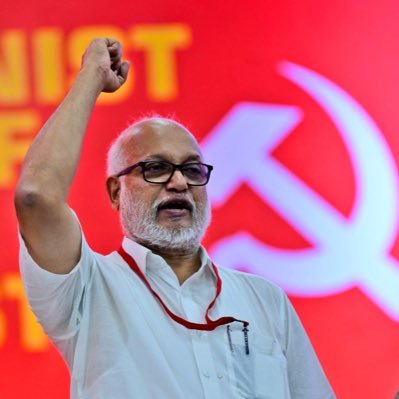
The Left has no reason to be disappointed by the current electoral and organizational weakness. The bankruptcy of neo-liberalism is becoming increasingly clear. In today’s political situation, almost all the major political forces are neo-liberal. Only the Left has an alternative perspective. This political space guarantees the future of the Left in India. CPI(M) General Secretary M.A. Baby said this in an interview given to the English fortnightly ‘Frontline’. In a discussion with TK Rajalakshmi, the CPI(M) General Secretary discussed the results of the recently concluded assembly elections and the future of the Left.
Can the left effectively address the challenges of neoliberalism, religious polarization, and identity politics within its ideological framework? Baby emphatically answers the question, “Of course, we need to continually update our political and ideological frameworks to address neoliberalism and identity politics. These do not provide real solutions to the fundamental problems of humanity.” We can move forward by linking it with the struggle for social justice while maintaining a class-based perspective. He said, the fight against communalism and religious polarization is also possible in this way. At the same time, a distinction must be made between ordinary religious believers and those who use religion as a political weapon. The former must be joined by the leftists in the struggle against the latter.
Who are the main opponents of the Left in India? In response to this question, the CPI(M) General Secretary said, “The ideological and political struggle against the BJP and the RSS is our immediate main task. This is linked to the struggle against extreme capitalist economic policies that are harming the common people. Besides, the oppression of caste, exploitation of women, protection of the rights of minorities and marginalized communities are also part of our main programme.”
How will the Left fight against anti-people policies with reduced representation in Parliament? In this context, Baby said, parliamentary politics is important, but we also build movements outside Parliament on issues related to people’s livelihood. The CPI(M) has organised 33 ‘Jan Akrosh Yatras’ in 13 states of North India, highlighting the problems of the rural poor, agricultural labourers, farmers, labourers and the common man. This culminated in a huge rally at Delhi’s Ramlila Maidan on March 24. He said that people’s livelihood issues should be raised more forcefully. Besides, it is also very important to maintain regular and close contact with the people at all levels.
Baby said, this is the first time since 1977 that there is no CPI(M)-led government in any state. Our influence outside parliamentary politics has also eroded to some extent. We are confident that we will be able to identify the reasons for this failure and will be able to turn around through self-criticism and correction. For this, we need to adopt appropriate new strategies without changing our fundamental politics. He said that it is difficult but not impossible to reach the youth and Gen-G generation with Leftist politics. New methods need to be developed to increase communication with them. He said that the growing religious fervor in India, communal polarization through its misuse and the planned propaganda that communists are anti-religious – such a special challenge is also before the Leftists. These need to be confronted.
Will the Left be able to reorganize itself outside the elections? Responding to this question, Baby said, if the Left cannot reorganize itself outside the elections, then the future of not only the Left but the entire country will be in danger. Standing by the contractual workers protesting in Noida is an example of that. No other political party or trade union has come forward in such a way. Embracing the desire for liberation of the working people is the main feature of Left politics. Responding to a question about countering the influence of money and corporate media, Baby said that politics has now largely been limited to electoral activities and elections are being controlled by huge money and corporate media. The Left needs to develop alternative communication channels – through neighbourhood meetings, direct public relations, etc. Kerala’s Kairali TV and the ‘Left Views’ portal are examples of such initiatives. He also expressed the view that the demand for electoral reforms should also be strengthened.
The CPI(M) general secretary also answered several questions about the results of Kerala and West Bengal. He said that in the last decade, the LDF government in Kerala has shown how it is possible to build a more egalitarian society, eradicate extreme poverty and ensure the basic needs of the common man within the constraints of India’s federal structure. At the same time, efforts have been made to solve educated unemployment by developing infrastructure and moving towards a knowledge-based economy. So why such a big electoral defeat in Kerala? Baby himself raised this question and said that the answer is complex. The poor are still with us, but a section of the middle class has moved away. Behind this is the influence of caste-community based identity politics. We suspect that there has been a strategic vote transfer between the NDA and the UDF in some centres. Although the LDF’s vote has decreased, the NDA’s vote percentage has also decreased. Now our main task is to find out why the votes have shifted. If there is a continuous government, there is a risk of degeneration.
We ourselves warned about this in the corrective document. It seems that we have not been successful enough in overcoming those weaknesses. The people expect higher standards from the Left, perhaps we have not been able to meet their expectations. So now a process of free and open self-criticism is underway, starting from the lower levels. In Kerala, social reform movements, freedom struggle, workers-peasants’ organizations, land reforms, wage hikes, universal education and health system are our historical foundations. So we have confidence that we will return to a leadership position.
What is the special challenge of recovery in West Bengal? In response to this question, Baby said that in this election, it has been possible to unite various small and big Left organizations, even the CPI(ML) Liberation. A large number of youth, students, women and elderly people have participated. Various mass movements, including big rallies, have received a good response. Now this movement has to be converted into votes.
We believe it will be possible soon. Asked about the veracity of the West Bengal Chief Minister’s claim that the CPI(M) helped the BJP in some constituencies, Baby said it was a clever political ploy by the Chief Minister, aimed at attracting CPI(M) supporters and left-wing people.
Our workers are quite politically aware. They understand the danger of RSS-controlled BJP. CPI(M) will continue its relentless struggle against the Sangh Parivar and BJP. Secularism, livelihood, anti-caste struggle and fight against exploitation – these are our main tasks. Such untruths are propagated to divert people’s attention from this reality.
Responding to a question about the dispute with India Manch and Trinamool Congress, Baby said, “Though Trinamool Congress is part of the India alliance, hundreds of our workers have been killed in West Bengal during their rule. There have been numerous false cases, rape, sexual assault, attacks and displacement. In such a situation, Mamata Banerjee’s call for anti-BJP unity is not appropriate.” He said that there are some problems in the work of India Manch. However, when the elections come, it will be possible to unite the various anti-BJP political forces according to the state-wise practical situation. Coordination will also be maintained in Parliament. However, in some states, staying together is difficult for practical reasons and cannot be avoided.
@freemang2001gmail-com


