

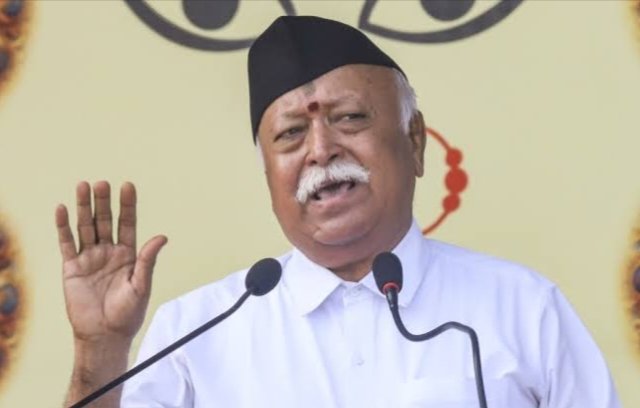
Mohan Bhagwat stated, “When Lord Curzon planned the partition of Bengal—intending to separate Bengalis and divide Muslims and Hindus—society rose up and vehemently opposed the plan. The British government was forced to withdraw its proposal.”
Mohan Bhagwat has dismissed the ‘credit’ often attributed to Syama Prasad Mukherjee for the partition of Bengal. Speaking from Nagpur on Tuesday at an event marking the founding day of the Sangh, the RSS chief criticized the division of Bengal along religious lines. This stands in contrast to the narrative promoted in West Bengal by the RSS and the BJP, who hail Syama Prasad Mukherjee as the architect of a ‘homeland for Bengali Hindus’—a claim that has also been echoed on several occasions by Suvendu Adhikari.On this day, Mohan Bhagwat stated, “When Lord Curzon planned the partition of Bengal—intending to separate the Bengalis and divide Muslims and Hindus—society stepped forward and vehemently opposed this plan. The British government was forced to withdraw its proposal. It was during this period that ‘Vande Mataram’ became a symbol of unity and patriotism. The division was averted.” Why, then, did the same outcome not occur in 1947? Because those who sought to divide us instilled in our minds the idea that we were different—that because we looked different, we must necessarily be different. Influenced by communal and extremist ideologies, we began to believe that outward differences implied a fundamental, deep-seated divergence.
Driven by separatism, a lust for political power, and self-interest, we gradually severed the bonds that once held us together. A culture of exclusionary partisanship further fueled this division. Ultimately, the country was partitioned. Yet, the promise that separation would bring peace and happiness remained unfulfilled. Instead, we have been left to contend with enduring hostility—both along our borders and within the nation—as well as mutual distrust, a sense of insecurity, and constant conflict over even the most trivial matters.
Based on the principles of the Bhagavata tradition, they have opposed the partition of Bengal. Why is the Sangh adopting this strategy now? Recently, the Sangh has initiated a strategy to expand its influence among Muslims. They have begun efforts to convince Muslims in India—including those in West Bengal—that they are not anti-minority.
@freemang2001gmail-com


