

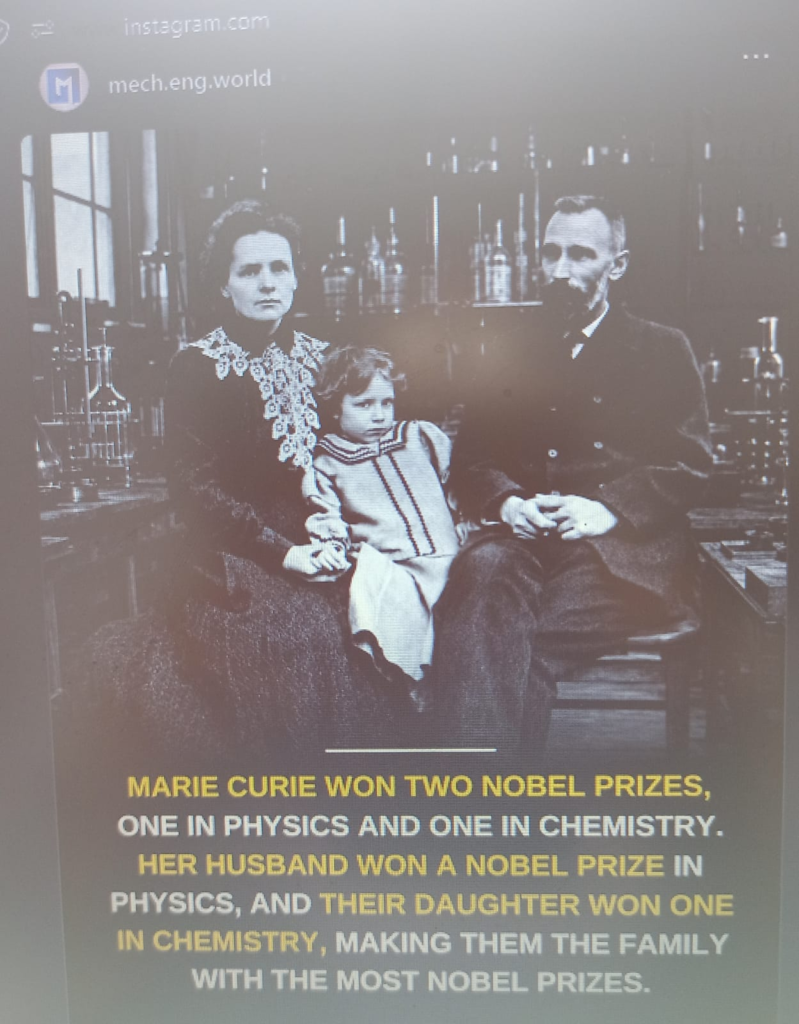
The extraordinary legacy of the Curie family represents the most decorated dynasty in the history of the Nobel Prize, amassing a total of five awards across two generations.
This unparalleled streak of genius began in 1903 when Marie Skłodowska-Curie and her husband, Pierre Curie, shared the Nobel Prize in Physics alongside Henri Becquerel for their groundbreaking research into radioactivity phenomena.
Defying the heavy gender biases of her era, Marie Curie secured her place in history a second time in 1911 by winning the Nobel Prize in Chemistry for isolating radium and discovering polonium, making her the first person ever to win twice and the only individual to win in two different scientific disciplines.
The family’s obsession with atomic secrets naturally passed down to the next generation, specifically to their eldest daughter, Irène Joliot-Curie.
Working alongside her husband, Frédéric Joliot-Curie, the brilliant duo successfully synthesized entirely new radioactive elements, an achievement that earned them the joint Nobel Prize in Chemistry in 1935.
While the rest of the family dedicated their lives to laboratory physics and chemistry, the youngest daughter, Ève Curie, pursued a distinguished career as a writer and international journalist, which ultimately introduced a unique humanitarian twist to the family’s historic medal count.
In 1965, Ève’s husband, the American diplomat Henry Richardson Labouisse Jr., was serving as the executive director of UNICEF when the organization was honored for its global efforts to promote brotherhood among nations.
Labouisse stepped forward to officially accept the Nobel Peace Prize on behalf of the humanitarian agency, effectively bringing the Curie family’s total haul to five.
This remarkable multi-generational run showcases a deep, shared commitment to global progress, cementing their reputation as a foundational pillar of modern science and international diplomacy.
READ MORE ON THI SUBJECT
Marie and Pierre Curie were the first married couple to win a Nobel Prize. Together, they shared the 1903 Nobel Prize in Physics with Henri Becquerel. Following Pierre’s untimely death in 1906, Marie Curie went on to win a second Nobel Prize—this time in Chemistry—in 1911.
A breakdown of their historic Nobel achievements:
1903 Nobel Prize in Physics
- Laureates: Marie Curie, Pierre Curie, and Henri Becquerel
- Awarded For: “In recognition of the extraordinary services they have rendered by their joint researches on the radiation phenomena discovered by Professor Henri Becquerel.”
- Significance: With this win, Marie Curie became the first woman to ever receive a Nobel Prize.
1911 Nobel Prize in Chemistry
- Laureate: Marie Curie (awarded solely following Pierre’s death)
- Awarded For: “In recognition of her services to the advancement of chemistry by the discovery of the elements radium and polonium, by the isolation of radium and the study of the nature and compounds of this remarkable element.”
- Significance: Marie Curie made history yet again as the first person (and to date, one of only two people) to win a Nobel Prize in two different scientific fields.
Would you like to know more about:
- The specific experiments and isolation techniques they used?
- The curium (Cm) element named in their honor?
- The subsequent Nobel Prizes won by the Curie family (like their daughter’s)?
@collected
@freemang2001gmail-com


