

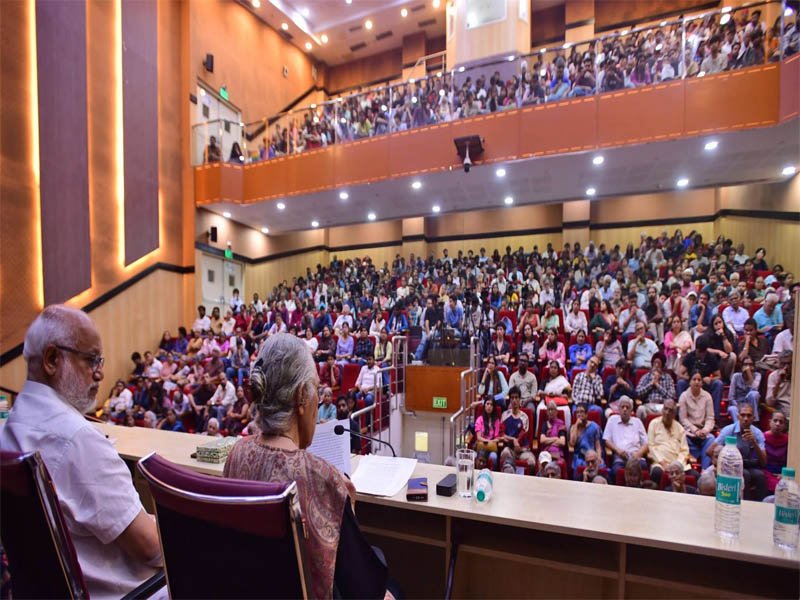
In contemporary India, history is being used as a tool to dismantle secularism and democracy. Attempts are underway to rewrite the past from the exclusive perspective of the religious majority. This concern was expressed by the eminent historian Romila Thapar. She was the keynote speaker at the Sitaram Yechury Memorial Lecture—titled “Historiography and the History of Ancient India”—held on Sunday at the Harkishan Singh Surjeet Bhawan in Delhi.
Thapar states that state-sponsored historiography is increasingly being turned into a tool for establishing a ‘Hindu Rashtra’ (Hindu nation). The professional, evidence-based, and factually rigorous study of history is being abandoned and repurposed to bolster the hegemony of the majority. She notes that the foundation of professional historical inquiry—built through decades of research—rests upon verified evidence, logical analysis, and the exploration of cause-and-effect relationships.However, this methodical approach to historical study is currently under attack. At one time, the study of pre-modern history was considered a quiet, scholarly pursuit. Today, however, historians who critically examine Hindutva-oriented narratives face persistent harassment and personal attacks on social media. Instead of recognizing the questioning of established historical interpretations as a natural part of the research process, a climate of hostility is being directed against these researchers.
Thapar notes that a fundamental shift occurred in the study of history from the mid-twentieth century onwards. Moving beyond mere accounts of ‘when’ and ‘where’ events took place, historians began to investigate ‘why’ and ‘how’ they occurred. This development fostered connections between historical study and various other disciplines, such as archaeology, comparative sociology, linguistics, and genetic research. These interdisciplinary links proved crucial for gaining a deeper understanding of past social systems, economic structures, social relations, cultural transformations, and the realm of beliefs.
However, in place of this scientific and analytical approach to history, there is a growing trend of what Thapar terms “pop history” (popular history). In these narratives—which proliferate across digital and social media—the necessity for verifying evidence, employing analytical methods, or conducting reasoned inquiry is disregarded. Complex historical events are reduced to simplistic tales and exploited for political ends. Alarmingly, such narratives are even finding their way into government-issued textbooks.
Thapar argues that the Hindutva-oriented approach to history presents India’s past as if a Hindu majority were the sole defining characteristic of the nation’s social history. In this interpretation, ancient India is portrayed as an ideal, monolithic ‘golden age.’ The subsequent arrival of Muslim rulers is depicted as the end of that golden age, with the claim that these rulers engaged exclusively in the oppression of Hindus.As a result, the multifaceted transformations throughout India’s long history are reduced to a simple narrative of religious conflict. Evidence gathered by professional historians calls the validity of this one-sided account into question. However, rather than engaging with such research on the basis of evidence, proponents of Hindutva resort to personal attacks. Any critical research is invariably dismissed with the label ‘Marxist.’
In analyzing the intellectual foundations of Hindutva politics, Thapar draws attention to a significant historical contradiction. She argues that the roots of the Hindutva approach to history actually lie within the colonial historiography of the nineteenth century. While, on one hand, proponents of Hindutva advocate for freeing Indian history from colonial influence, on the other, they reproduce—in new language—the very divisive concepts introduced by those same colonial historians.
In this context, he refers to James Mill’s The History of British India (1817). Mill divided Indian history into Hindu, Muslim, and British periods, thereby attempting to characterize Hindus and Muslims as two mutually antagonistic nations. This narrative later became one of the foundations for the ‘two-nation theory,’ which paved the way for the Partition. In truth, to establish a historiography free from colonial influence, one must also subject Hindutva to critical scrutiny.
Thapar also rejects the tendency to portray India’s pre-modern history as a continuous series of religious wars. She argues that, in many instances, the desire for imperial expansion was the primary cause of conflict; interpreting these as religious conflicts amounts to a distortion of historical reality. Similarly, in ancient India, ideological clashes between the Brahmanical religious authority and the shramana traditions—such as Buddhism, Jainism, and the Ajivika school—also played a significant role.
In this context, citing the 1576 Battle of Haldighati, Thapar notes that communal interpretations often frame it as a conflict between Hindus and Muslims. In reality, however, the struggle centered on political authority. Maharana Pratap’s forces included a significant contingent of Afghan soldiers led by Hakim Khan Suri. Conversely, the Mughal army of Akbar was commanded by a Rajput ruler, Raja Man Singh. In other words, one side consisted of a Hindu king’s forces led by an Afghan commander, while the other comprised the Mughal emperor’s army led by a Rajput commander. Thapar also refutes the claim made by colonial rulers that Indians lacked a historical consciousness. She points out that pre-colonial India possessed a rich tradition of preserving, interpreting, and systematically recording the past. Examples of this include Banabhatta’s Harshacharita, Sandhyakara Nandi’s Ramacharitam, and the Rajatarangini, as well as the thousands of stone inscriptions and copper-plate charters found across the country.
Thapar also addressed the debate surrounding the origins of the Aryans and the genesis of Indian civilization. Proponents of Hindutva seek to portray the development of Indian civilization as the exclusive contribution of an indigenous Aryan population. However, Thapar pointed out that this claim is inconsistent with various findings from archaeological and genetic research.Archaeological investigations reveal fundamental differences between the urban life, script usage, and economic structure of the Harappan civilization and the pastoral-based character of Vedic society. Furthermore, recent genetic research has provided evidence of the migration and intermingling of populations. Consequently, any attempt to frame the history of Indian civilization as the story of an uninterrupted and purely indigenous development of a single population group must be called into question.
Thapar also criticizes attempts to confine India’s religious heritage within a monolithic, unchanging, and singular identity. She argues that Hinduism has never been a linear system; rather, it has evolved through a variety of sects, regional modes of worship, philosophical doctrines, dissenting views, and shifting traditions of devotion. Within this diversity lay a tendency to question established religious authority.Citing examples from the Bhakti movement, he notes that while the worship of Vishnu in the form of Jagannath in Odisha and of Vitthal in Maharashtra are linked to the broader Vaishnava and Bhakti traditions, they also possess their own distinct regional characteristics. Any attempt to construct a monolithic religious identity by disregarding this plurality is inconsistent with the historical reality of India.
In her concluding remarks, Romila Thapar calls for the preservation of historical inquiry as a vital intellectual endeavor. The foundation of professional historical research lies in the impartial examination of evidence, the application of reason, and the freedom to question established notions. Rewriting history to serve political agendas not only distorts the interpretation of the past but also jeopardizes the democratic and secular values of contemporary society.Yet, expressing confidence in the power of professional research, he states that evidence-based historical inquiry will continue to expose the fallacies of the misinterpretations and fabricated narratives propagated by majoritarian hegemony.
Economist C. P. Chandrasekhar delivered the opening remarks at the memorial lecture. Expressing gratitude towards Romila Thapar, CPI(M) General Secretary M. A. Baby stated, “A prerequisite for understanding the present is an accurate analysis of history. We are living in a time when a constitutional institution like the Supreme Court is basing its verdicts not on evidence, but on the beliefs held by a particular community. The Supreme Court is delivering judgments, but it is not delivering justice.”In this context, Romila Thapar has explained in detail how crucial it is to grasp the importance of evidence in history and historiography.
@freemang2001gmail-com


